Connecting the dots: How Peter Mbah and President Tinubu are building a new Enugu

BY BABAJIDE FADOJU
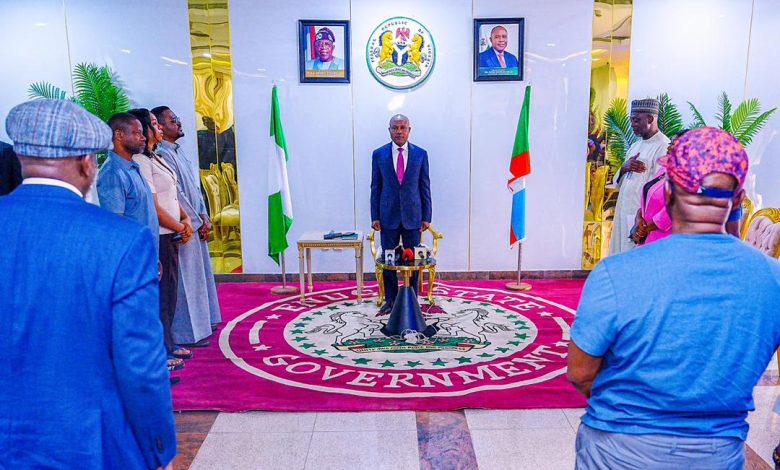
There is a phrase that echoes through every conversation with Governor Peter Mbah of Enugu State: “connecting the dots.”
It is not a political slogan. It is a governing philosophy. And it is the only way to make sense of the unprecedented wave of infrastructure sweeping across Enugu.
From the concession of the Akanu Ibiam International Airport to the creation of a new smart city bigger than Paris, from 267 smart green schools to 260 farm estates, from a world‑class international hospital to a security network that has ended the sit‑at‑home era, every project is deliberately linked to a single audacious goal: growing Enugu’s economy from $4.4 billion to $30 billion by 2031.
That goal, when Governor Mbah first announced it, was met with scepticism. A 27 percent compound annual growth rate seemed impossible, given the historical trajectory of the state.
But as the Governor explained during an exclusive interview with the Renewed Hope media team, “We realised that we needed to do things differently. This is going to be an era of quantum leap, disruptive innovation. That growth is going to be government‑enabled but private sector‑driven.”
And the enabler of that vision? President Bola Ahmed Tinubu’s bold economic reforms, particularly the removal of the fuel subsidy, which freed up resources for sub‑nationals to act at scale.
THE SUBSIDY REMOVAL: A GAME‑CHANGER FOR ENUGU
Governor Mbah was unequivocal about the impact of the president’s policies. “I think it would have been impossible, to say the least, for us to have done things at the scale we did without some of the bold and courageous policies of Mr. President. What the policies of Mr. President did for sub‑nationals is largely to free up resources.”
He contrasted this with the struggles of his predecessor, who often had to choose between paying salaries and funding capital projects. Today, Enugu is building new cities, airports, and schools because the federation account is now delivering more funds to the states.
The removal of subsidies, the unification of the exchange rate, the tax reforms, and the NELFUND policy have all contributed to a fiscal environment where ambitious state governments can thrive.
Without security, none of this works. Governor Mbah invested heavily in technology, deploying AI‑enabled cameras, a distress response squad (DRS), and a command‑and‑control centre.
He also worked with federal security agencies to end the illegal sit‑at‑home order, which once paralysed the state. “If you have done nine things well and there’s an error in one, that one gets magnified and diminishes everything you’ve done,” the governor noted.
So, the state monitors its nine gateways, uses body cams and helmet cams on officers, and works collaboratively with the army, police, DSS, and civil defence. The result is a state where investors can feel safe and a key barrier to private capital has been removed.
AVIATION AND TOURISM: THE GATEWAY TO THREE MILLION VISITORS
The airport concession is a critical dot. Governor Mbah explained that Enugu’s target is to bring in three million visitors annually.
That requires 100 aircraft landings per day, a number impossible under the old regime where only four or five flights operated daily. So, the state set up Enugu Air, now operating close to 20 flights daily, and worked with an investor to successfully concession the Akanu Ibiam International Airport.
This is the first airport in Nigeria’s history to be successfully concessioned, and the Governor gave full credit to President Tinubu. “It took Mr. President standing behind this deal for this success to be recorded. Very soon, you will be able to get a direct flight from Enugu to the US, the UK, and China,” he said.
To attract those visitors, the state is building four immersive tourism sites, including the longest zip line in Africa and a cable car system. These are not isolated attractions; they are pull factors designed to fill the airport and drive the hospitality sector.
THE NEW ENUGU CITY BUILT IN RECORD TIME
The most visible symbol of this ambition is the New Enugu Smart City. Spanning 10,000 hectares, it is bigger than Phase 1 of the Federal Capital Territory (FCT) and comparable in size to Paris.
The first phase is already under construction, with a six‑kilometre primary dual carriageway built to higher standards than Abuja’s roads. One hundred kilometres of secondary and tertiary roads are being constructed simultaneously, a scale unmatched by any district in the FCT.
All utilities; electricity, water, fibre optics, sewage, and surveillance are underground. There will be no overhead cables, no generators, no boreholes. It is a smart, liveable city designed for a 15‑minute walk lifestyle.
The international hospital being built in Enugu is designed to capture a share of the $2 billion annual medical tourism market. Equipped with SPECT and PET scanners, it will provide advanced oncology diagnostics and treatment. “If you’re bringing in an investor, two things matter: security and where they go when they are sick,” the Governor said. By building a world‑class hospital, Enugu is removing another barrier to investment.
EDUCATION: 267 SMART GREEN SCHOOLS AND A NEW PEDAGOGY
Education is the longest‑term investment. Enugu has dedicated 33 percent of its budget to education for three consecutive years, building 7,000 classrooms and 267 smart green schools. The new pedagogy is experiential learning, moving away from rote memorisation to problem‑solving.
Teachers are trained at the Centre for Experiential Learning and Innovation (CELI), and students learn practical skills from age three. The Governor’s logic is unassailable: “If we don’t get these kids skillfully equipped, they will take to criminality as a venture tomorrow. So we might as well spend that money today, training them”.
Agriculture is not just about food security; it is big business. Enugu is building 260 farm estates, each 200 hectares, ring‑fenced and equipped with tractors, implements, agronomists, storage, and aggregation centres. Small‑holder farmers are being transformed into mechanised commercial farmers. The state is also building agro‑processing zones in conjunction with the federal government and Afreximbank, connecting production to exports.
The genius of the Mbah administration lies in how each initiative reinforces the others. The international airport and the new airline are essential to the tourism sector, which is essential to achieving the $30 billion GDP target. The New Enugu Smart City is designed to attract the investors and skilled professionals needed to drive economic transformation, which in turn relies on the security infrastructure that makes the state safe.
The education reforms are designed to create the skilled workforce needed for the jobs generated by the new economy. The healthcare investments are designed to make the state a destination for quality care, which again serves both residents and visitors. This is not a list of projects; it is a meticulously planned ecosystem.
THE DOTS ARE CONNECTED
Governor Mbah’s vision was made executable by President Tinubu’s subsidy removal, which gave states the fiscal space to dream big.
And his determination to connect the dots has resulted in a coherent, integrated development strategy that is already delivering results. As the Renewed Hope media tour has shown, Enugu is not waiting for the future. It is building it, one dot at a time.