Benue’s concrete testament: How the renewed hope agenda is building bridges, brewing hope, and rewriting a state’s future

BY BABAJIDE FADOJU
The journey to BeBenustate began with a ritual that has become all too familiar to the Nigerian traveller: a seven-hour flight delay courtesy of Air Peace.
Sitting on the tarmac at Murtala Muhammed International Airport in Lagos, watching the minutes bleed into hours, munching on excuses after excuses from the helpless staff of Air Peace.
The airline, to its little credit, would later cite the delay over of some engine issues coupled with weather unpredictability and to add, baggage screening machine at the Nnamdi Azikiwe International Airport in Abuja as the reason for the disruption.
But for the ordinary passenger, the message is always the same: your time is not a priority.
It is a fitting prelude to a conversation about infrastructure, because if there is one thing Nigerians understand intimately, it is the cost of inefficiency and the value of connectivity.
Nothing teaches you to appreciate a well-built road like spending hours you will never get back waiting for an airline to get its act together. And nothing makes you appreciate a government that builds bridges like watching another government agency fail at something as basic as baggage screening.
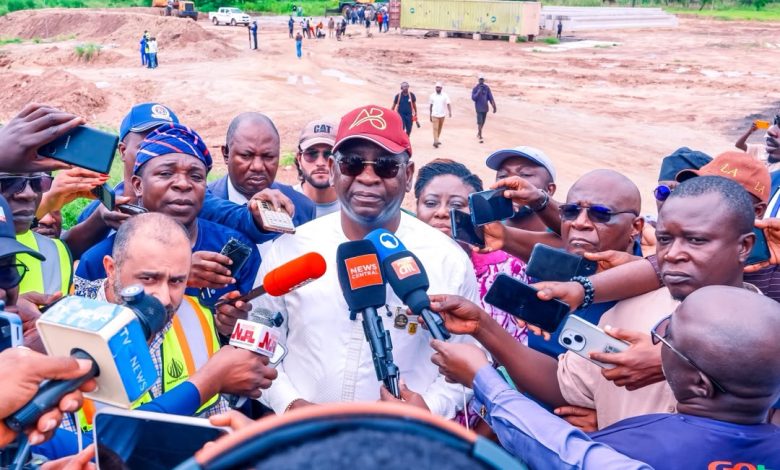
But once the wheels finally touched down in Abuja, and I found my way to Makurdi to join the presidential media team, under the renewed hope ambassadors initiative; we began the inspection of federal and state projects across Benue, the frustration of the journey quickly faded.
What I saw was not a state waiting for salvation but a state actively building its future.
The evidence is everywhere: on the massive Buruku Bridge spanning the Katsina-Ala River, on the expanding dual carriageways, and in the hum of industrial revival at the Taraku Mills.
The presence of the First Lady, Senator Oluremi Tinubu, who had just inaugurated 10 intra-city roads and an ICT centre in the state, underscored the administration’s multi-layered approach.
This was not a photo op; it was a declaration that the renewed hope agenda is not a slogan but a delivery mechanism.
The 10 roads, covering 11.5 kilometres and featuring 3.4 kilometres of drainage channels, were constructed at a cost of N15 billion, a tangible investment in the daily lives of Makurdi residents .
The centrepiece of the tour was the 854-metre Buruku Bridge, a dual-carriageway project that the Deputy Governor, Samuel Ode, rightly described as “a golden gift to the people of Benue state”.
For decades, the Katsina-Ala River had been a source of life and death, its waters claiming over 200 lives in boat mishaps in the last three years alone.
The bridge, which will link Buruku, Loko, Katsina-Ala, and Ukum LGAs to Taraba state, is not just a crossing; it is an economic lifeline.
It will give the farmers of the Sankera federal constituency, Benue’s yam-producing belt, direct access to markets in southern Nigeria, ending the perilous alternative routes that had choked commerce and cost lives.
Bayo Onanuga, the special adviser to the president on information and strategy, defended the administration’s borrowing policy by pointing to the visible results: “As Nigerians, we see that the government has been accused of borrowing money. But we can also see where the money is going; to develop infrastructure, link people who had been forgotten, ensure commerce flows freely and enable farmers to move their produce straight to the markets” .
Mukaila Danladi, the federal controller of works in Benue, confirmed that the project, funded under the renewed hope infrastructure fund, has no funding problems and is on course for completion by December 2027.
All substructures, including piles, pile caps, and pillars, are complete, and precast beams are ready for installation after the rainy season .
Beyond the concrete and steel, the tour revealed a strategic push for industrialisation that has been largely overlooked.
The revived Taraku Mills, set for a test run within the next 30 to 35 days, is designed to process soybeans, maize, and cassava into edible oil, animal feed, and beer grits for the newly established Food Basket Brewery .
The brewery, which produces Zeva Beer and Zeva Malt, has already created more than 1,000 direct and indirect jobs and sources sorghum from local farmers through an out-grower scheme .
This is not charity; it is a deliberate strategy to create a circular agricultural economy, linking farmers to industry and ensuring that Benue’s status as the nation’s food basket translates into prosperity for its people.
As the GMD of BIPC explained, the revival of Taraku Mills is part of Governor Hyacinth Alia’s industrialisation agenda to restore moribund industries and boost economic growth. It marks a shift from extracting raw materials to adding value, a crucial step for any developing economy.
The first lady’s inauguration of the Lucy Zaiyol Alluor Community ICT Centre in Vandeikya, the fourth of its kind under the NITDA-RHI partnership, further reinforces this digital and economic empowerment drive.
This visible development, from the high-level underpass in Makurdi to the Wurukum flyover, has had a profound political effect.
The Benue state government, led by Governor Alia, has attributed this progress to the increased fiscal space created by President Tinubu’s reforms and the direct federal intervention under the renewed hope agenda.
The deputy governor was unequivocal in reaffirming the state’s promise to deliver over one million votes to the President in 2027.
This was not a political slogan delivered from a podium, but a statement made on the ground, beside the bridges and the breweries that are reshaping the state.
Even the Tor Tiv, the paramount ruler of the Tiv nation, has applauded the ongoing construction of the Buruku bridge while appealing for more federal roads.
In Benue, the people are seeing the dividends of democracy with their own eyes, and they are ready to reward the leadership that made it possible.