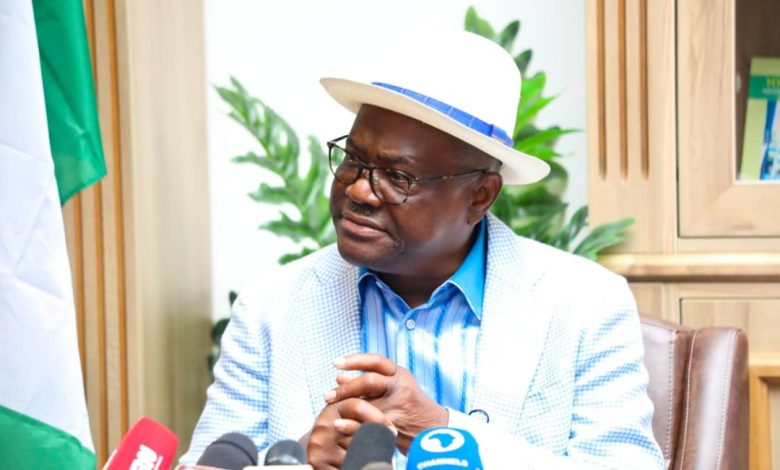
BY TITUS CHONKULA
Nyesom Wike, minister of the Federal Capital Territory (FCT), is one of Nigeria’s most forceful political voices.
The principle is sound. Public office is a public trust, and governors must explain how public money is used. But a principle gains credibility only when it is applied consistently—not merely when it is delivered forcefully against a political opponent.
FROM CRITIC TO ALLY
Yet their relationship later changed. Ahead of the 2023 presidential election, Wike and Ortom became allies in the G5, the group of five PDP governors: Wike, Ortom, Seyi Makinde, Okezie Ikpeazu and Ifeanyi Ugwuanyi, that opposed the party’s presidential arrangement and demanded a shift of the national chairmanship to the south.
There is nothing wrong with political reconciliation. Politicians may disagree, cooperate and later find common cause. But the episode raises a fair question: if Ortom’s record once justified Wike’s criticism, what changed when they became allies? Did Wike revise his assessment of Ortom’s governance, or did shared political interest become more important than earlier concerns?
The public record shows the shift in their relationship; it does not reveal Wike’s private motives. Still, it illustrates the danger of allowing political friendship to determine when scrutiny is demanded and when it is quietly set aside.
RIVERS AND THE EMERGENCY
The more immediate test lies in Rivers state. The prolonged conflict between Wike and his successor, Governor Siminalayi Fubara, became a major political crisis involving control of the state’s political structure, a divided house of assembly, impeachment threats and a breakdown in executive-legislative relations.
The crisis culminated on March 18, 2025, when President Bola Tinubu declared a state of emergency in Rivers. Fubara, his deputy, Ngozi Odu, and members of the state house of assembly were suspended for an initial six months, while Vice Admiral Ibok-Ete Ibas (retd.) was appointed sole administrator.
Wike was central to the public debate. The confrontation was between him and the governor he had helped bring to office, and his continuing influence in Rivers politics made him a key figure in the dispute. In April 2025, he publicly supported the president’s intervention, saying he had wanted Fubara removed outright and arguing that Tinubu had acted to prevent anarchy.
That position demands scrutiny. A serving minister publicly endorsing the removal of an elected governor with whom he had a political dispute cannot plausibly present himself as a detached observer. This is not to say Wike alone caused the crisis, nor to excuse Fubara or the legislature. It is to insist that responsibility for a crisis serious enough to suspend democratic institutions must be examined across all its principal actors.
Reporting at the time noted that the president’s address focused criticism on Fubara while saying little about Wike’s role in the conflict. That imbalance matters. Accountability cannot mean assigning blame to one side while exempting another simply because the latter is politically influential.
THE SOLE ADMINISTRATOR QUESTION
In a petition to the house of representatives, they called for a transparent investigation of expenditure during his tenure and raised concerns about decisions affecting local government and democratic structures.
Titus Chonkula, a concerned citizen, writes from Kaduna