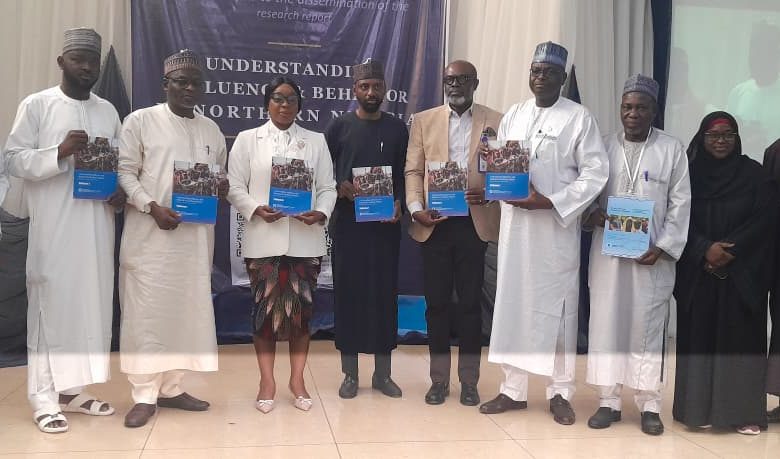
About four in every 10 women in northern Nigeria lack access to financial services, a new report by the Aminu Kano Centre for Democratic Studies, Bayero University Kano, has revealed.
The report, titled “Understanding influence and behaviour in northern Nigeria”, was unveiled in Abuja on Wednesday.
According to the findings, 38 percent of women across the region lack access to financial services.
The report stated that 52 percent of women are financially served, while 45 percent access formal financial services through deposit money banks, merchant banks, interest-free banks and microfinance institutions.
An additional seven percent utilise other formal non-bank financial products, including insurance services.
Despite these gains, the report noted that a significant proportion of women still lack access to both formal and informal financial systems.
The researchers recommended that state governments and the private sector establish targeted training and mentorship programmes for women and girls to prepare them for leadership roles.
They also urged the introduction of workplace inclusion policies such as flexible working hours for mothers, alongside policies that promote women’s economic empowerment through skills acquisition, improved access to credit and support for women-owned businesses.
The report further stressed the need to strengthen financial literacy programmes and establish sustainable funding mechanisms to improve women’s access to economic resources in the region.
Speaking with journalists on the sidelines of the unveiling, Ismael Zango, principal investigator of the study, said the findings on poverty and unemployment align with data from the National Bureau of Statistics (NBS).
He disclosed that unemployment in the region stands at about 37 percent, while poverty levels average about 80 percent across northern Nigeria.
Zango added that Sokoto State recorded the highest poverty rate at over 80 percent.
He emphasised that economic empowerment must go beyond token financial support, noting that sustainable development requires equipping women and youths with relevant, market-driven skills.
Zango cited examples of women’s organisations in Kebbi state engaged in groundnut processing and the Women in Agriculture initiative in Kano State as models that should be expanded.
“These initiatives should be scaled up to bring more people into productive economic activities and reduce poverty,” he said.
Also speaking, Habu Fagge, director of the centre, described the study as a significant step in understanding financial inclusion challenges in the region.
He said the research highlights institutional, cultural and attitudinal barriers affecting women’s participation in the financial system.
Fagge noted that addressing gender disparity in financial inclusion is critical to economic development.
“If we bridge the gap in financial access, particularly through FinTech platforms, it will translate into grassroots development,” he said.
On his part, Yusuf Garba, who represented the vice-chancellor of the university, said the findings underscore the need for behavioural change in addressing financial exclusion.
He noted that a large proportion of the northern population falls within the study demographic.
Meanwhile, Foyinsolami Akinjayeju, chief executive officer of Enhancing Financial Inclusion and Advancement, described financial inclusion as both a moral and economic necessity.
She stressed that expanding financial services to underserved populations presents significant business opportunities.
Akinjayeju called for stronger collaboration among stakeholders, including government, financial institutions and development partners.
“Everyone has a role to play, but commitment must come from the top,” she said.