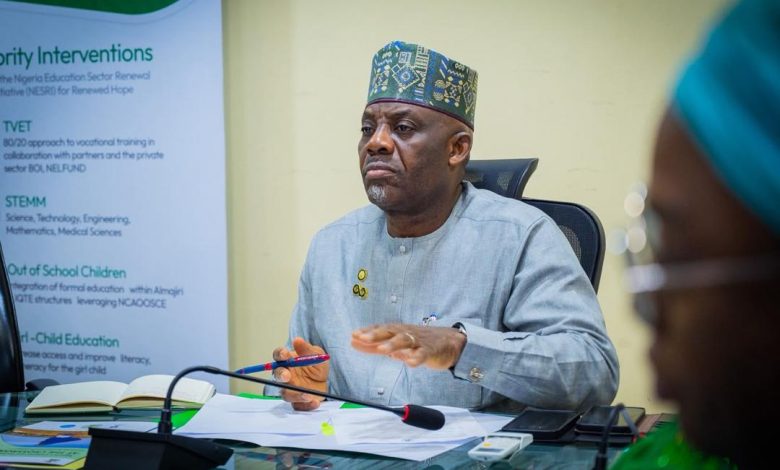
Tunji Alausa, minister of education, says President Bola Tinubu has delivered almost 100 percent of the promises he made during the 2023 presidential campaign.
Alausa spoke in Abuja while receiving the outcomes of the 2025 Nigeria 2050: Child foresight analysis for futures literacy and intergenerational equity.
The initiative is part of the anticipatory governance and foresight capacity programme of the office of the vice-president and is supported technically by UNICEF.
The child foresight team was led to the minister’s office by Chris Ngwodo, its director-general, and Mohammed Ahmed, special assistant on special duties to the vice-president.
Alausa said the findings of the foresight analysis are particularly important given Nigeria’s youthful population, with about 70 percent of the estimated 220 million population below the age of 30.
He said the demographic composition presented both an opportunity and an urgent responsibility for the government to convert the country’s youthful population into a demographic dividend through quality education, relevant skills, productive opportunities and long-term planning.
According to the minister, the changes under Tinubu are not merely political rhetoric but are reflected in reforms and outcomes across various sectors, particularly education.
“I can assure you of that one fact because today we have a President who is leading the country, managing this country from the front, with the highest level of integrity, commitment, patriotism and determination to change the face of this country,” he said.
“And these are not just rhetorics we are hearing now. These are things we are seeing, with a lot of tangible benefits and tangible change in the country.”
‘NIGERIA HAS A LOT OF CATCHING UP TO DO’
Alausa said three years into the administration, Nigeria had moved beyond the uncertainty that previously characterised national development and is now focused on consolidating its gains while addressing areas where significant work remained.
“The country is not at a crossroads again. We have a lot of catching up to do,” he said.
He said Tinubu’s commitment to education was evident in the support given to the Federal Ministry of Education to implement reforms under the renewed hope agenda.
According to him, education remains central to the administration’s ambition of moving Nigeria towards a $1 trillion economy.
He said the Nigerian education sector renewal initiative (NESRI) was driving reforms across the education system, with emphasis on technical and vocational education and training (TVET), science, technology, engineering and mathematics (STEM), teacher quality, quality assurance, reducing the number of out-of-school children, and strengthening education data and digitalisation.
‘TVET CENTRAL TO SKILLS DEVELOPMENT’
The minister said the renewed emphasis on TVET was changing perceptions of technical education and creating pathways for young Nigerians to acquire practical skills, pursue entrepreneurship, secure employment and progress to higher levels of education.
“Skills are the present and the future,” Alausa said, stressing that Nigeria could no longer afford an education system that failed to adequately prepare young people for the modern economy.
He said technical education had previously been an integral part of Nigeria’s education system but suffered decades of neglect and declining public confidence.
The federal government, he said, was deliberately restoring technical and vocational education to the centre of the national education system because of its importance to employment, productivity and economic growth.
Alausa also linked investment in medical education and professional training to efforts to address skills shortages contributing to the migration of Nigerian professionals, popularly referred to as “Japa”.
He said the government was expanding access to nursing education and increasing training capacity in existing teaching hospitals, federal medical centres and specialist hospitals rather than relying solely on constructing new institutions.
The objective, he said, was to provide more Nigerians with access to high-quality professional training at home while developing a skilled workforce capable of competing internationally.