Osinbajo warns declining public trust is putting African democracy under pressure

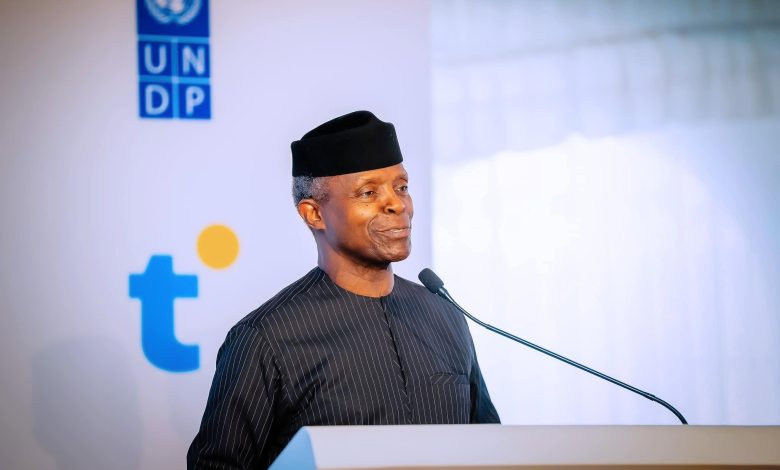
Former Vice-President Yemi Osinbajo has warned that declining public trust in democratic institutions is putting democracy under pressure across Africa.
Osinbajo spoke while delivering the keynote address at Good Governance Africa’s (GGA) annual lecture, on 22 October, in Accra, Ghana, themed “Democracy under pressure: Rebuilding trust, accountability, and institutional integrity in Africa’s new political era.”
He urged governments to strengthen accountability, uphold constitutional rule and ensure that democratic systems deliver tangible benefits to citizens.
He cited findings from Afrobarometer’s 2024 flagship report, based on surveys conducted across 39 African countries between 2021 and 2023, which showed that although 66 per cent of respondents preferred democracy to other forms of government, only 37 per cent were satisfied with how democracy was working in their countries.
Osinbajo also said 53 per cent of respondents were prepared to tolerate a military takeover if elected leaders abused power for their own interests.
The former vice-president said the findings reflected a growing gap between citizens’ support for democracy and their experience of democratic governance, warning that the inability of governments and institutions to meet public expectations could further weaken confidence in constitutional rule.
“Democracy in Africa is clearly under pressure,” he said, identifying military interventions and declining public trust in governments and institutions responsible for protecting citizens’ rights as major sources of concern.
According to the ex-vice president, Africa experienced 11 successful coups in nine countries between 2020 and 2025. While acknowledging that the circumstances surrounding the takeovers differed, he said their cumulative effect was to weaken the principle that political authority should be acquired and exercised through constitutional processes.
He cautioned that the continent’s democratic challenges could not be understood solely through military takeovers, noting that elected leaders could also undermine constitutional government by manipulating political rules and restricting opportunities for genuine political change.
However, Osinbajo said dissatisfaction with elected governments should not automatically be interpreted as a rejection of democracy.
Citing a 2023 United Nations Development Programme (UNDP) survey of 8,000 African citizens, he said only 11 percent of respondents in countries that had experienced unconstitutional changes of government preferred non-democratic forms of government.
He argued that the priority should be to address the governance failures that fuel public frustration while strengthening institutions that protect citizens’ rights and hold those in power accountable.
‘ACCOUNTABILITY, PUBLIC SERVICES KEY TO REBUILDING TRUST’
The discussions at the lecture highlighted the relationship between institutional integrity, accountability and Africa’s development prospects.
Robert Rose, founder and outgoing global chairman of GGA, said the organisation was established over a decade ago to advance independent research, policy analysis and engagement with policymakers, civil society, businesses, communities and the media.
Rose said the organisation’s work was founded on the conviction that Africa’s development could not be separated from the quality of its governance.
He identified the gap between the existence of laws and oversight institutions and the actual enforcement of accountability as a persistent challenge, arguing that corruption must have consequences and public resources must be used for their intended purposes.
Rose also highlighted GGA’s involvement in the campaign for an International Anti-Corruption Court, a proposed international mechanism intended to address grand corruption in cases where national authorities are unable or unwilling to hold perpetrators accountable.
He said the proposed court would complement national justice systems rather than replace them, providing an additional avenue for accountability where domestic institutions fail to act.
Rose estimated that corruption costs the world US$2.6 trillion annually, underscoring the scale of the problem and its implications for public resources and development.
He further argued that effective governance was essential to attracting investment, noting that businesses required predictable rules, enforceable contracts and institutions capable of ensuring fairness.
He said the organisation needed partners willing to invest not only in individual projects but also in the institutional capacity required to sustain its research, continental networks and response to emerging governance challenges.
“The work we have discussed today … none of these can be sustained by conviction alone,” he said.
He called for stronger collaboration among governments, parliaments, the judiciary, businesses, civil society, the media, academia, development partners and young people, arguing that democratic renewal required shared responsibility across society.
Rose, meanwhile, said institutions must be capable of outliving their founders. He outlined a long-term vision for GGA to expand its continental presence, including the establishment of nine regional centres over the next 10 to 15 years, while acknowledging the need for funding, partnerships and sustained leadership to realise the ambition.