When the familiar becomes abstract: Nneka Jackson-Akhigbe at the Abuja photo festival

BY SABO KPADE
In Nneka Jackson-Akhigbe’s photographs, colour, repetition and perspective transform familiar environments into intricate visual compositions.
Crowded spaces become fields of overlapping forms, where the boundaries between representation and abstraction begin to shift. In Yellow Lines of Convergence, presented at the 10th Abuja photo festival, the Nigerian artist explores how the organisation of everyday scenes can alter the way we perceive space, movement and human presence.
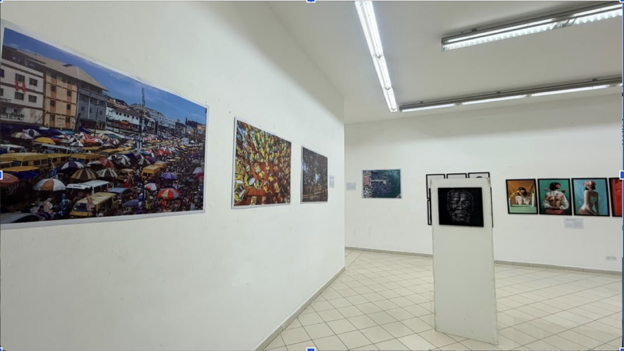
One photograph, taken from an elevated perspective, presents a dense arrangement of yellow vehicles, market umbrellas and human figures. The repeated yellow forms establish a loose visual rhythm, interrupted by clusters of red, blue and purple.
Rather than directing the viewer towards a single subject, Jackson-Akhigbe allows the eye to wander across the composition, encountering smaller patterns within the larger scene. The photograph’s strength lies in this tension between order and excess, where the familiar becomes unexpectedly difficult to read.
Elsewhere, a composition dominated by warm reds, oranges and yellows pushes this visual language further. Figures and objects overlap, compressing the space into an almost painterly surface. The distinction between foreground and background becomes less pronounced, while colour assumes a greater role in organising the image.
Jackson-Akhigbe’s approach is particularly effective here: the photograph retains its connection to an identifiable world while resisting the immediate clarity usually associated with photographic representation.
The quieter landscape within the presentation introduces a different visual register, suggesting that the artist’s interest extends beyond the spectacle of densely populated spaces. Yet it is the more saturated compositions that leave the strongest impression. Their visual richness is compelling, although the attraction of pattern occasionally threatens to overshadow the human presence from which it emerges.
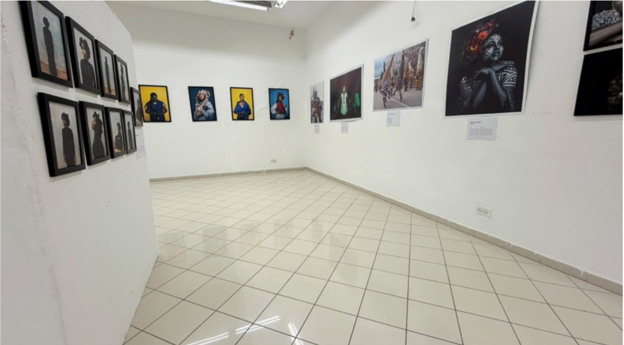
The series was presented within an international exhibition featuring 63 photographers working across portraiture, landscape, documentary and experimental image-making. Across the gallery, differing approaches to colour, identity and representation offered a broad view of contemporary photographic practice. Jackson-Akhigbe’s contribution offered an investigation of how photographic perspective can transform visual complexity into an aesthetic experience.
What makes Yellow Lines of Convergence interesting is not simply the density of its subjects, but the ambiguity of looking at them. These are photographs in which representation and abstraction remain in productive tension. Jackson-Akhigbe does not entirely resolve that relationship, but her strongest images demonstrate a sensitivity to colour, repetition and the possibilities of the photographic frame.