FG launches push for financially resilient universities through advancement programme

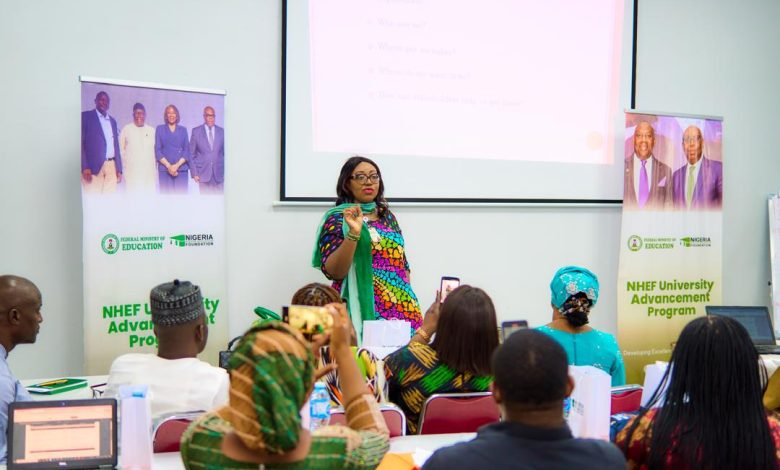
The federal government has reaffirmed its commitment to building financially resilient, globally competitive and future-ready universities through the national university advancement programme (NUAP).
Tunji Alausa, minister of education, described the initiative as a strategic intervention to strengthen institutional sustainability and position Nigeria’s higher education system for long-term growth.
The minister while delivering a keynote address at the closing ceremony of the NUAP training for university officials in Abuja.
He was represented by Adetola Salau, his special adviser on science, technology, engineering, mathematics and medical sciences (STEMM) and corporate sector engagement.
Alausa described the programme as more than the conclusion of a training exercise, noting that it represents a renewed national commitment to building stronger universities with the institutional capacity, partnerships and systems required to compete in the global knowledge economy.
He reaffirmed President Bola Tinubu administration’s commitment to supporting higher education but stressed that universities must also strengthen their internal systems, cultivate strategic partnerships and deliberately engage their alumni to unlock opportunities for research, innovation, scholarships, infrastructure development and sustainable institutional growth.
“The National University Advancement Programme is not intended to replace government support for higher education,” the minister said.
“Rather, it complements existing investments by creating additional pathways for sustainability, innovation, research support, scholarships and long-term institutional growth.”
Alausa said the NUAP was established through a partnership involving the federal ministry of education, the Nigeria higher education foundation (NHEF) and the Africa Finance Corporation (AFC) to institutionalise professionally managed advancement offices across federal universities and inter-university centres.
According to him, the offices will serve as centres for alumni engagement, donor relations, endowment management, strategic communications, resource mobilisation and institutional partnerships.
He said the initiative would help universities strengthen their financial resilience, expand research opportunities and improve their global visibility.
The minister noted that Nigerian universities possess one of their greatest untapped assets in their alumni, many of whom have distinguished themselves in business, science, medicine, technology, entrepreneurship and public service within and outside the country.
“When universities maintain strong relationships with their alumni, research receives greater support, students gain access to scholarships and mentorship opportunities, institutions build stronger partnerships, infrastructure improves and innovation expands,” he said.
Alausa added that the federal government’s vision is to build universities that are financially stronger, capable of long-term planning, driven by robust research ecosystems and globally competitive while remaining responsive to Nigeria’s development priorities.
He said the training programme was designed to equip university leaders and advancement teams with practical knowledge, global best practices and institutional frameworks on alumni engagement, donor stewardship, fundraising and sustainable university development.
The minister urged participants to implement the knowledge acquired by establishing systems that promote accountability, strengthen institutional trust, improve governance and enhance the overall student experience.
He also reaffirmed that the federal government’s education reform agenda under the Renewed Hope Agenda is focused on strengthening institutions, expanding access to quality education and positioning the sector as a catalyst for national development.
Also speaking, Wale Adeosun, chairman of the Nigeria Higher Education Foundation (NHEF) and founder and chief executive officer (CEO) of Kuramo Capital Management, urged Nigerian universities to prioritise alumni engagement and institutional advancement as sustainable sources of revenue.
Adeosun said the broader objective is to help universities become financially self-sustaining through diversified revenue streams.
He stressed that establishing university endowment funds through alumni contributions would provide institutions with the financial flexibility to invest in critical areas such as infrastructure, scholarships, research and teaching facilities.
Claire Jemide, chairman of the technical working committee of the Nigeria Higher Education Foundation, described the organisation as a strategic partner committed to strengthening Nigeria’s higher education ecosystem through sustained investment in people, institutions and collaborative partnerships.
She said the foundation’s work has expanded from supporting outstanding students through the NHEF Scholars Programme to advancing faculty development, healthcare leadership, university governance and institutional transformation.
According to Jemide, the university advancement programme, launched following the signing of a memorandum of agreement between the federal miinistry of education and the NHEF in January 2026, represents another milestone in equipping Nigerian universities with the systems and strategies needed to strengthen alumni engagement, fundraising, communications and long-term institutional advancement.
The National University Advancement Programme brought together vice-chancellors, university administrators, advancement officers and senior officials from federal universities and inter-university centres for intensive training on global best practices in institutional advancement, donor stewardship, alumni relations and sustainable university development.