BY BABAJIDE FADOJU
For decades, the south-east geopolitical zone of Nigeria has worn the heavy cloak of marginalisation. It has been a narrative repeated in town hall meetings, on radio call-in programmes, and in the corridors of power.
The region that gave Nigeria its first indigenous President, its most renowned industrialists, and some of its finest intellectuals has, paradoxically, often complained of being left behind in the distribution of national infrastructure. Roads crumbled.
Bridges collapsed. Federal projects were inaugurated with fanfare, only to be abandoned to weeds and neglect. The cry was always the same: “We are not part of the centre.”
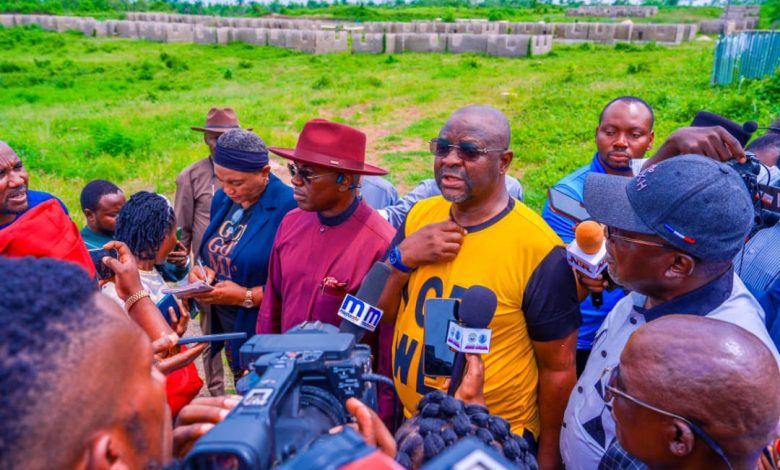
But something has changed. Over five days in June 2026, from the rocky terrain of Ebonyi to the bustling city of Enugu, from the farmlands of Abia to the commercial hubs of Anambra and Imo, the renewed hope media tour of the south-east laid bare a new reality. What the delegation of over 50 editors, journalists, and presidential aides witnessed was not a region waiting for development.
It was a region where development had already arrived—on concrete pavements, in smart schools, through free housing, and across newly constructed flyovers.
The narrative of neglect is no longer tenable. And the man at the centre of this transformation, President Bola Ahmed Tinubu, has, through his renewed hope agenda, done what many thought impossible: he has begun to heal a wound that had festered for generations.
THE ARCHITETURE OF RENEWAL: HOW SUBSIDY REMOVAL UNLOCKED THE SOUTH-EAST
To understand the scale of what is happening in the South-East, one must first understand the fiscal revolution that made it possible. Governor Peter Mbah of Enugu state, during the tour, was characteristically blunt. He stated that increased financial support to subnational governments under President Tinubu’s administration has been responsible for the remarkable infrastructure development in the state.
“It would have been impossible, to say the least, for us as a state to have done things at a scale we did without some of the bold and courageous policies of Mr. President,” he declared. “First of all, what the policies of Mr. President did for subnationals is largely to free up resources”.
This is the core of the renewed hope agenda: a belief that economic growth does not come from the top down, but from the periphery upward. President Tinubu has been intentional about strengthening the periphery, both in terms of responsibility and finance.
The removal of the fuel subsidy, the unification of exchange rates, tax reforms, and the Nigerian Education Loan Fund (NELFund) have collectively created a fiscal environment where states can dream big.
The evidence is unmistakable. Before these reforms, many states struggled to pay salaries and had little left for capital expenditure.
Today, as Bayo Onanuga, special adviser to the president on information and strategy, observed in Ebonyi, “The state is conceiving projects it would never have thought of before. It is doing those projects without having to go to the bank to borrow money”.
This is not rhetoric. This is the tangible result of a federal government that has chosen to empower its subnational units rather than suffocate them.
EBONYI: FROM THE SAFEST TO THE MOST AMBITIOUS
The tour began in Ebonyi state, and what the delegation found was nothing short of extraordinary. Governor Francis Nwifuru has declared his state the safest in Nigeria, with no reported kidnapping cases since he assumed office. But safety, it turns out, is only the foundation. On top of it, Nwifuru has built an ambitious programme of infrastructure development that rivals anything seen in the region.
The federal government’s Trans-Saharan Superhighway, a colonial-era dream long forgotten, is now being brought to life under the Tinubu administration. Minister of works, Senator Dave Umahi, himself a former governor of Ebonyi, described the project as strategic to the south-east, south-south, and parts of the north-central region.
Section One, initially 118 kilometres, has been extended to 123.6 kilometres with a contract sum of N45 billion, and dualisation works are ongoing. Section two, running from the Aboadi border through Benue and Kogi to Nasarawa, has been awarded at N668 billion.
The project has reached about 28 percent completion in some areas, with work continuing even during the rainy season, thanks to President Tinubu’s adoption of concrete road technology.
The Onueke Flyover, a N35 billion federal project designed to decongest the Trans-Saharan highway, stands as a testament to the scale of federal investment in the region. Standing 90 metres high and flanked by a 2.2-kilometre road on both sides, it is not just infrastructure; it is a statement.
But the state’s ambition extends beyond federal projects. The 22-kilometre Izeagu-Azulu rural road, connecting four communities with an eight-inch concrete pavement, exemplifies the state government’s commitment to rural connectivity.
The conversion of an abandoned trade centre into a multi-storey modern hotel, the construction of the Ebonyi State University of Aeronautics and Aerospace Engineering Science, and the free housing estates for civil servants all point to a government that is using its increased federal allocations to dream big. As Onanuga put it, “Ebonyi state, in particular, is dreaming big and doing big things”.
ENUGU: CONNECTING THE DOTS TO A $30 BILLION ECONOMY
If Ebonyi represents ambition, Enugu represents audacity. Governor Peter Mbah has set a target to grow the state’s economy from $4.4 billion to $30 billion by 2031. To achieve this, he is connecting the dots across multiple sectors—aviation, tourism, security, education, healthcare, and urban development.
The concession of the Akanu Ibiam International Airport is a critical piece of this puzzle. This is the first airport in Nigeria’s history to be successfully concessioned.
The Enugu state government has also established Enugu Air, with six aircraft acquired in phase one, to ensure consistent airlift capacity independent of third-party schedules. The target is to bring in three million visitors annually, requiring 100 aircraft landings per day. This is not fantasy; it is a carefully calibrated plan to transform Enugu into a tourism and investment destination.
The New Enugu Smart City is another component of this vision. Spanning 10,000 hectares, it is bigger than Phase 1 of the Federal Capital Territory and comparable in size to Paris.
The first phase alone covers 1,000 hectares—twice the size of Victoria Island. All utilities—electricity, water, fibre optics, sewage, and surveillance—are underground. There will be no overhead cables, no generators, no boreholes. It is a smart, liveable city designed for a 15-minute walk lifestyle. And it will be delivered by November 2026.
But Mbah is equally focused on the fundamentals. The state has dedicated 33% of its budget to education for three consecutive years, building over 7,000 classrooms and 267 smart green schools equipped with robotics centres, AI hubs, and 3D printers.
The pedagogy has been reformed from rote learning to experiential learning, with teachers trained at the Centre for Experiential Learning and Innovation (CELI). The logic is unassailable: “If we don’t get these kids skilfully equipped, they will take to criminality as a venture tomorrow. So, we might as well spend that money today, training them.”
The 300-bed Enugu International Specialist Hospital, equipped with MRI machines, cancer treatment facilities, and modern surgical theatres, is designed to capture a share of the $2 billion annual medical tourism market. The 38.6-kilometre Enugu–Onitsha–Port Harcourt concrete pavement road, the dualisation of the 21.5-kilometre Enugu International Airport road, and the Abakpa flyover interchange bridge are all evidence of a government that is building for the long term.
Senator Osita Ngwu, representing Enugu west, captured the mood of the region when he declared: “To be honest, I was among those who previously felt that Enugu and the south-east had been neglected by the federal government. But that is now a thing of the past. Under President Bola Tinubu’s administration, we have been carried along”.
He cited the Eke Obinagu flyover, the reconstructed Enugu-Port Harcourt Expressway, and the Enugu-Onitsha road as evidence that the south-east is no longer marginalised. “How can we be marginalised when we have the Honourable Minister for Works for the first time? And who is performing? We cannot be marginalised”.
ABIA: A GOVERNOR WITHOUT PARTY COLOURS, DELIVERING WITH FEDERAL SUPPORT
The tour in Abia State offered a different but equally compelling narrative. Here was a governor from the Labour Party (LP), Dr. Alex Otti, working seamlessly with a federal government led by the All Progressives Congress (APC).
Sunday Dare, special adviser to the president on media and public communication, noted that “political party differences make no difference when it comes to governance”. “When it comes to the development of your people, you don’t essentially have to wear party colours. Because when you play too much party politics, development suffers, and your people suffer”.
The projects inspected in Abia were impressive. The 67-kilometre Umuahia–Uzuakoli–Akara–Ohafia Road, a state-financed project, connects over 20 communities and facilitates the movement of agricultural produce. The Omenuko Bridge along the Ohafia–Umuahia corridor strengthens critical transportation infrastructure serving thousands of commuters. The Nnenna Otti Bus Terminal in Umuahia is a modern transportation hub designed to transform public transportation in the state.
But the highlight was the renewed hope housing estate in Umuahia, a flagship federal government project comprising 1,200 housing units. The Abia state government provided the land and paid compensation to affected landowners, while the federal government, through the federal housing authority, is undertaking the construction.
This is collaboration at its best—federal and state governments working together to address the nation’s housing deficit. The Onuinyan Bende renewed Hope housing project, another significant development, further underscores the federal government’s commitment to reducing the housing deficit through strategic investments in affordable housing.
THE UNIFYING THREAD: INCLUSION, NOT MARGINALISATION
What ties these three states together is not just the scale of projects, but the philosophy behind them. President Tinubu’s renewed hope agenda has been deliberate in ensuring that development does not bear tribal marks. As one official put it, “The vision is that it does not bear tribal marks or ethnic marks. So long as you are part of a Nigerian state, development will reach you”.
This is a significant departure from the past. For decades, the South-East complained of exclusion. Today, that complaint no longer holds water. Senator Ngwu’s admission that he was among those who felt marginalised but now sees the evidence of federal investment is a powerful testimony to the shift that has occurred.
Minister Umahi’s declaration that “all our forefathers sought—inclusiveness—we have it now” is a fitting epitaph for the old narrative of neglect.
The Renewed Hope Housing projects are a perfect example of this inclusivity. In Kano, houses are at about 60 percent completion. In Abuja and other states, they are at 45 percent. In Abia, progress is at about 35 percent. This is not a project for one region or one tribe; it is a national programme. The vision is that it does not bear tribal marks or ethnic marks. So long as you are part of a Nigerian state, development will reach you. That is a powerful statement of intent, and it is being backed by action.
THE CRITICS AND THE FACTS
Of course, there will be critics. There are always critics. Some will say the projects are not enough. Others will question the quality. A few will even deny what is plainly visible. But the evidence from the Renewed Hope Media Tour is overwhelming.
Over five days, across five states, the delegation saw completed flyovers, ongoing expressway reconstructions, smart schools, specialist hospitals, housing estates, and ambitious new cities. These are not “audio projects”—they are concrete, steel, and glass.
The improvements on the Enugu-Port Harcourt Expressway alone have reduced travel time from five to six hours to just over two hours. That is not a marginal improvement; it is a transformation. The Eke Obinagu Flyover has resolved a long-standing transportation problem on the route connecting Enugu and Ebonyi states. The concession of the Akanu Ibiam International Airport will soon allow direct flights from Enugu to the US, UK, and China. These are not promises; they are achievements.
A NEW DAW FOR THE SOUTH-EAST
The renewed hope media tour of the south-east has accomplished what no press release could: it has provided irrefutable evidence that the region is no longer neglected. Under President Bola Ahmed Tinubu, the south-east is being rebuilt road by road, bridge by bridge, school by school, and house by house. The fiscal reforms of the Tinubu administration, particularly the removal of the fuel subsidy, have given states the resources to dream big and deliver. And the governors of the region have risen to the occasion, executing projects that were once considered impossible.
The narrative of marginalisation is no longer tenable. It is time for the South-East to recognise that it is now part of the centre. It is time for the region to celebrate its inclusion rather than mourn its exclusion. And it is time for Nigerians across the country to see that the renewed hope agenda is not a slogan; it is a strategy that is delivering tangible results in every corner of the nation.
As President Tinubu’s Special Adviser, Sunday Dare, noted: “By the time we conclude our assessment across the six geopolitical zones, Nigerians will have enough evidence that the President is working for the country”. The South-East tour has provided that evidence. The region is no longer waiting for development. It is living it.