By Ozolua Uhakheme
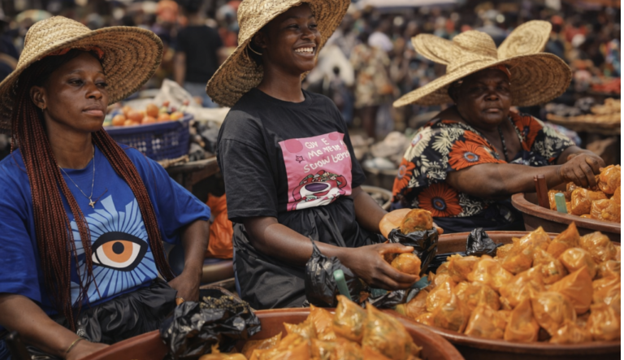
Three woven hats establish the first rhythm in Uche Rita Okolie’s Market Sisters. Their broad circular forms sweep across the upper section of the photograph, visually connecting three women whose expressions, gestures and positions remain distinctly their own.
Beneath them, a concentrated field of orange produce fills the foreground, while blue, black and patterned fabrics divide the image into sharply defined areas of colour.
Exhibited at the Chania Photo Festival in Greece from 9 to 13 July 2026, Market Sisters is less concerned with describing a marketplace than with transforming an everyday encounter into a study of form, presence and pictorial balance.
At the centre, a woman stands slightly higher than the figures beside her, smiling openly towards the camera. To the left, another looks beyond the frame, her expression more contained, while the woman on the right appears absorbed in the activity before her. Okolie brings these different states of attention together without forcing them into a single emotional register.
The women share the same pictorial space, yet they are never reduced to a collective type. Gesture, gaze and posture preserve their individuality.
The repeated hats provide the photograph’s strongest formal connection. Large and almost sculptural, they create an irregular sequence across the frame, stabilising the visual density of the marketplace behind them. Their curved forms are echoed by containers and goods below, producing a subtle geometry that becomes increasingly apparent the longer the image is observed.
Colour performs a similar structural role. The orange foreground behaves almost like an abstract plane, pushing the women visually upward. Against this warmth, the saturated blue of the left-hand figure’s shirt commands attention, while the central figure’s darker clothing provides a moment of visual restraint.
The patterned fabric worn by the woman on the right connects her both to the orange foreground and to the more complicated field of colour behind her.
Okolie therefore uses the marketplace not merely as setting, but as material for composition.
The background remains crowded without becoming dominant. Bodies, umbrellas and market activity recede into softened layers, creating atmosphere while keeping the three women securely in the foreground. This tension between abundance and control is one of the photograph’s most convincing qualities.
There are echoes of Seydou Keïta’s sensitivity to posture, clothing and self-possession. Keïta’s celebrated portraits were produced under the controlled conditions of the studio, while Okolie works within the unpredictability of a public environment. Yet both recognise how gesture and surface can establish an individual presence within a photographic frame.
Okolie’s image, however, is not a conventional portrait. The central woman acknowledges the camera directly, while the others seem differently engaged with the surrounding space. These contrasting relationships to the lens produce an ambiguity that prevents the photograph from settling into a simple group study.
The title Market Sisters extends that ambiguity. “Sisters” need not describe literal kinship. The relationship between the women is constructed visually through proximity, repetition and rhythm. The hats connect them; their bodies establish a loose triangular arrangement; their differing expressions simultaneously hold them apart.
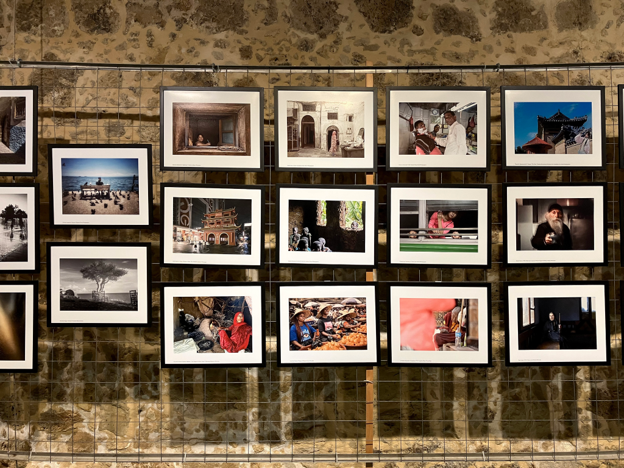
Within the wider Chania Photo Festival installation, these formal qualities became especially visible. Displayed among photographs of architecture, landscape, portraiture and quieter interior scenes, Market Sisters distinguished itself through its density and saturated colour. Even from a distance, the orange foreground and repeating hats gave the image a clear visual identity.
Where neighbouring works often depended upon emptiness or isolation, Okolie’s photograph was built through accumulation. The frame is full, but never uncontrolled.
That fullness is essential to the work. Goods become fields of colour, hats become geometry, hands become gestures and the surrounding crowd becomes texture. What begins as an apparently straightforward scene gradually reveals itself as a carefully organised system of visual relationships.
Market Sisters ultimately succeeds because Okolie allows connection and difference to coexist. The three women are brought together by the composition without surrendering their individuality.
Sisterhood, in this photograph, is not sentimentalised. It is built through form.
And it is through that architecture of colour, gesture and presence that Okolie turns an ordinary encounter into a compelling fine-art photograph.