By Ozolua Uhakheme
At first sight, the boats in Miracle Okafor’s Vessels of Memory appear ready for a journey. Look more closely and that expectation begins to shift.
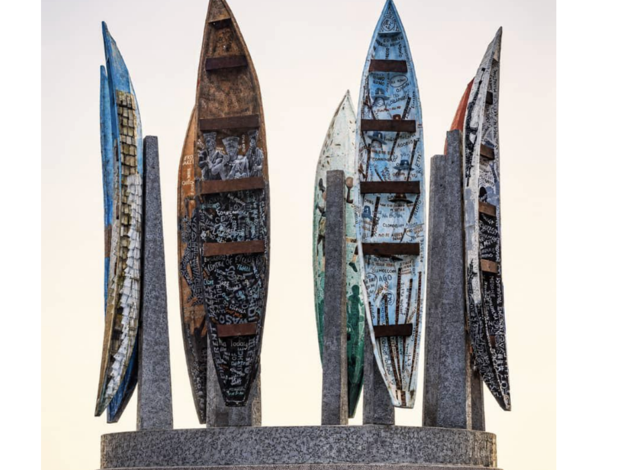
The vessels have left the water, risen vertically and assumed the presence of monuments. Their pointed forms reach towards an open sky while photographs, handwritten words, scratches and fragments of colour accumulate across their surfaces. Beneath them, a solitary figure sits quietly at the base, diminished by the histories towering overhead.
Shown in Where Memory Lives at Nommo Gallery, Kampala, in July 2024, Vessels of Memory finds Okafor considering how objects and places absorb traces of the lives that pass through them. The exhibition brings together questions of memory, identity, place and time, and Okafor approaches these concerns through an unusual transformation: a familiar object associated with travel becomes fixed, monumental and seemingly built to endure.
The title provides a useful entry into the work. A vessel travels, but a vessel also holds. Okafor allows both meanings to operate simultaneously. Although the boats are immobilised, they appear burdened with journeys, stories and accumulated experience. Their surfaces have become repositories, crowded with marks that suggest histories too numerous to fit within a single account.
One vessel is predominantly brown and densely inscribed; another is washed in blues and pale greens. Photographic fragments, handwriting and graphic marks overlap across their surfaces. Some details seem briefly legible before disappearing into the wider composition. That partial readability is important. Memory seldom returns as an orderly archive. It survives in fragments, altered by time and retelling, with certain details remaining unexpectedly vivid while others become difficult to recover.
Okafor makes this incompleteness part of the work’s visual language. The viewer is given enough information to recognise the presence of histories without being granted complete access to them. What appears written upon the vessels functions less as explanation than accumulated evidence. These boats have carried something, even if we cannot completely know what.
Their vertical orientation is among the work’s most effective decisions. Removed from the horizontal plane usually associated with water and travel, the boats begin to resemble standing figures, architectural fragments or pieces of public sculpture. Grey pillars rise alongside them while a broad circular base anchors the composition, strengthening the impression of a civic monument. An object made for movement has been transformed into something commemorative.
Yet Okafor complicates the authority usually associated with monuments. Public monuments often present history as settled, giving permanence to particular people, events or collective narratives. The surfaces of Vessels of Memory suggest something far less stable. They are weathered, overwritten and visually crowded. History appears not as a single inscription carved permanently into stone, but as an accumulation of voices and traces continually competing for space.
The small human figure seated beneath the structure changes the emotional temperature of the image. Initially easy to overlook, the figure provides a measure of scale that makes the vessels suddenly immense. The person’s dark clothing contrasts with the lighter architectural base, drawing attention to a body that appears temporary beside objects presented as if they might survive generations.
Okafor leaves the relationship between the figure and the structure deliberately unresolved. There is no obvious ceremony taking place and no gesture that tells us how to interpret the scene. The person might be resting, remembering, mourning, waiting or simply passing through. That uncertainty prevents the work from becoming an illustration of a predetermined story. The solitary presence instead introduces the possibility that every public history eventually encounters private memory.
This tension sits comfortably within Where Memory Lives, an exhibition concerned with the ways landscapes, monuments and familiar environments acquire emotional, cultural and psychological resonance. In Okafor’s contribution, that idea becomes almost literal. The vessels look physically loaded with memory, while their monument-like presentation suggests the effort involved in preserving what time continually threatens to alter.
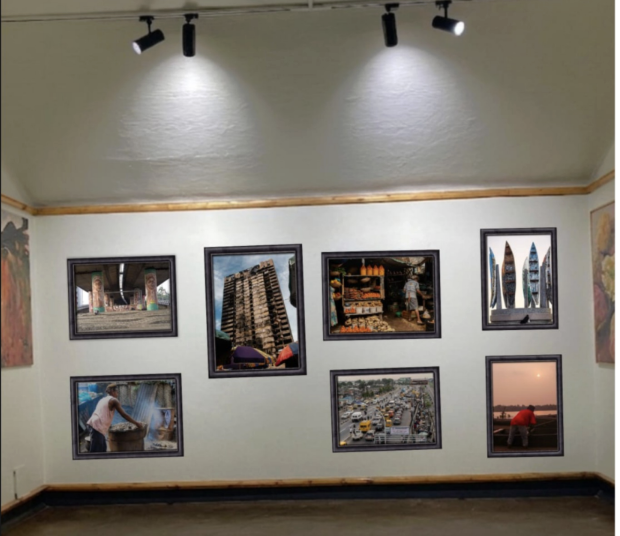
There is also something significant in the way Okafor treats the photographic image itself. Photography is often valued for its ability to hold an instant, preserving visible evidence of a particular encounter. Here, the photograph becomes a foundation for further intervention. Batik, inscription and texture complicate the apparent certainty of the photographic surface, suggesting that preserving something and remembering it are not necessarily the same act.
Colour contributes quietly to this effect. Weathered browns sit beside muted blues, greys, whites and pale greens, giving the vessels distinct characters without disturbing the unity of the structure. Their distressed surfaces resist polish. They appear to have endured exposure, movement and repeated human contact, reinforcing the sense that time has acted upon them.
What prevents Vessels of Memory from slipping into nostalgia is Okafor’s refusal to present the past as intact. His vessels preserve traces, but those traces have been layered, obscured and written over. The work acknowledges memory as a source of continuity while recognising how unreliable that continuity can be. What survives is rarely identical to what existed before.
This is where the work moves beyond the straightforward representation of a monument. Okafor uses boats, architecture and human scale to consider what societies choose to carry forward and how those inheritances change as they move between generations.
The solitary figure beneath the vessels gives the question a human dimension: monuments may appear permanent, but their meanings ultimately depend upon people continuing to encounter, interpret and remember them.
Vessels of Memory is strongest in these contradictions. Boats intended for movement have become stationary. Objects capable of carrying physical cargo now appear loaded with intangible histories. A monumental structure suggests permanence while its surfaces reveal alteration and wear. Beneath it all sits a human presence whose smallness reminds us that memory may outlive individuals even as it depends upon them.
In this meeting of passage and permanence, Miracle Okafor creates an image that treats remembering as an active process. His vessels do not preserve the past neatly. They carry its fragments forward, marked by what has been retained, what has changed and what can no longer be completely recovered.