BY OZOLUA IHUAKHEME
Presented as part of the group exhibition “Where Memory Lives” at Nommo Gallery, Kampala, from 1–27 July 2024, Funmilayo Kayode’s Scars of a Living City offers a compelling meditation on urban endurance, memory, and the emotional weight of place.
Within an exhibition concerned with the relationship between people, landscape, history, and belonging, Kayode’s work occupies a striking position: it turns the city itself into a bearer of memory.
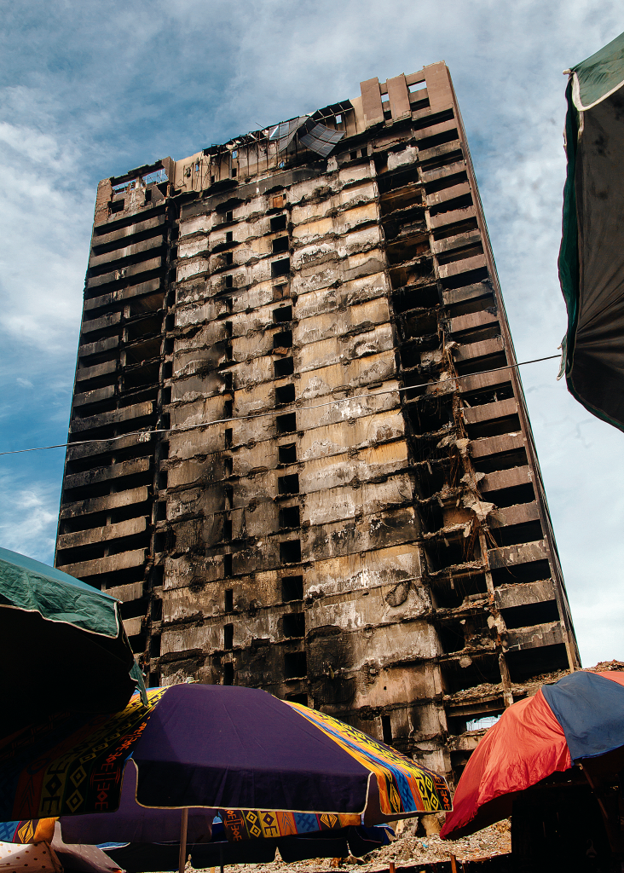
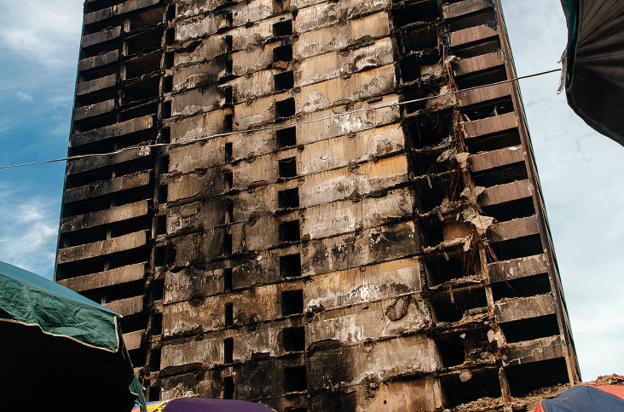
The photograph centres on a tall, weathered building rising above the street, its façade darkened, fractured, and marked by time. The structure appears almost bodily.
Its damaged surface reads as skin, scar tissue, or evidence of prolonged exposure. Yet Kayode does not frame the building as ruin alone. Beneath it, the bright presence of umbrellas and street-level activity introduces colour, scale, and movement.
This contrast between architectural severity and everyday life gives the image its force. The city is wounded, but it is not empty. It continues to breathe through commerce, passage, shelter, and human persistence.
Kayode’s composition is direct but carefully charged. The verticality of the building dominates the frame, giving the work a monumental quality, while the lower section of the image anchors it in the lived reality of the street. The umbrellas are especially important.
They interrupt the heaviness of the façade with flashes of colour, suggesting not decoration, but survival. They speak to the improvisational intelligence of urban life, where people continue to create shelter, trade, and movement beneath structures that carry the strain of history.
In the context of “Where Memory Lives,” Scars of a Living City becomes more than an image of urban decay. It proposes the city as an archive. Memory is held not only in monuments or official histories, but also in damaged walls, ageing surfaces, crowded streets, and buildings that remain standing despite neglect or transformation. Kayode’s photograph asks the viewer to consider how place records pressure. Lagos, through her lens, is not treated as a backdrop, but as an active presence: layered, scarred, restless, and alive.
The work is also significant for what it refuses. It does not romanticise hardship, nor does it aestheticise collapse for spectacle. Instead, Kayode approaches the urban environment with restraint and attention. Her image allows beauty and damage to occupy the same frame without forcing resolution between them. The photograph’s power lies in this tension: between endurance and vulnerability, monumentality and fragility, the built environment and the human lives moving beneath it.
Installed among works that engage labour, water, markets, monuments, and symbolic forms, Scars of a Living City functions as an architectural anchor within the exhibition. It expands the show’s concern with memory by locating remembrance in the surfaces of the contemporary city. The building becomes a witness, not silent, but visibly marked. Its scars are not merely signs of deterioration; they are traces of social, economic, and historical pressure.
Kayode’s practice is strongest when it allows the ordinary to become symbolic without losing its material specificity. In Scars of a Living City, she presents the city as a living organism shaped by damage, adaptation, and continuity. The image is neither nostalgic nor pessimistic.
It is a study of persistence. Through this work, Kayode reminds us that cities remember through what they carry, what they conceal, and what they continue to survive.