Gesture, adornment and presence: Uche Rita Okolie at FEAAN International Women’s Day exhibition

BY OZOLUA UHAKHEME
Art has always been a conversation, but at the Female Artists Association of Nigeria (FEAAN) International Women’s Day Exhibition, it felt more like a chorus.
Held in partnership with Alliance Française Owerri on March 21, 2026, the exhibition gathered a vibrant array of contemporary pieces, creating a space where women’s experiences and voices could speak directly to one another. Among the kaleidoscope of colours and textures, one piece caught the eye not by shouting, but through its profound simplicity: a photographic portrait by Uche Rita Okolie.
Okolie’s featured work stands apart because of its direct, human approach. The photograph captures a woman looking straight at the viewer, dressed in a striking white garment, positioned against a woven backdrop and adorned with rich, coral-toned ornaments across her head and neck.
Her hands are raised in a gesture that immediately suggests openness; a warm greeting or a ceremonial acknowledgement. She wears a genuine smile, but this is far from a simple, cheerful snapshot. Beneath the surface brightness lies a deliberate, deeper study of how a woman occupies space, both as an individual and as a symbol of her culture.
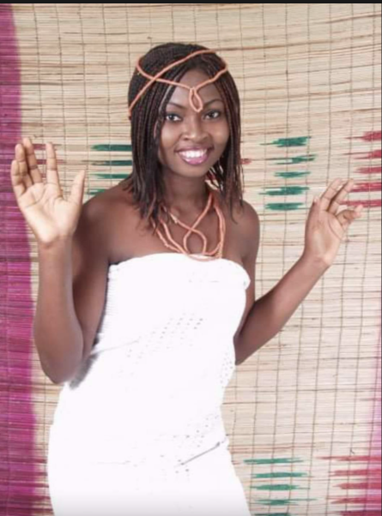
The real power of the image is in this gesture. By lifting her hands, the subject breaks the stillness of the traditional, frontal framing. The movement signals welcome, confidence, and declaration. Within the context of an International Women’s Day showcase, this quiet assertion of presence speaks volumes. It tells the story of a woman making herself visible, not through loud confrontation, but through poise, composure, and self-possession.
The choice of background and adornment adds layers of meaning. The woven backdrop provides a textured, cultural frame, grounding the figure in an environment deeply tied to tradition, domestic space, and material heritage.
Against this rustic surface, the coral ornaments are not just accessories; they serve as lines of heritage written across the body, drawing the eye to the performative language of traditional dress.
Okolie’s use of light and colour is equally compelling. The white dress dominates the lower half of the frame, contrasting sharply with the subject’s skin tones and the vivid coral jewellery. While white traditionally evokes purity, ceremony, or renewal, here it also creates a fascinating visual tension. The light reflecting off the garment is so bright that it almost softens the edges of her silhouette, making her appear as though she is emerging directly from the light itself—held beautifully between softness and visibility.
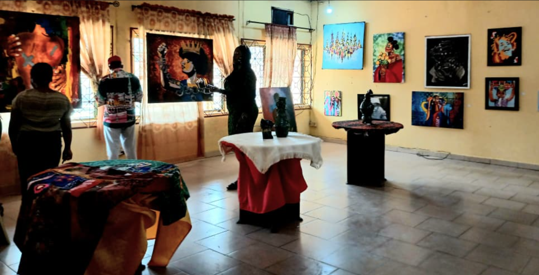
Walking through the gallery, the installation views showed Okolie’s work locked in a lively dialogue with bold paintings, abstract compositions, and intense figurative pieces by her peers. While many artists relied on heavy painterly strokes and dramatic colours to explore identity, Okolie’s photograph offered a calmer, more reflective anchor.
This restraint is exactly what makes the piece so accessible. It does not hide behind overly complex or cryptic symbolism. Instead, it invites the viewer in through a familiar human expression, holding their attention with the fine details of the pose and cultural styling.
It is strongest when viewed simply as a portrait of feminine selfhood, showing not just what the woman looks like, but how she chooses to present herself to the world.
Admittedly, this directness brings a bit of creative tension. Because the image relies on the immediacy of a personal portrait, it risks appearing less formally complex than some of the heavily layered multimedia works surrounding it. A tighter control over the lighting or scale might have given it a sharper technical edge. Yet, that very lack of excessive staging is its true strength; the subject meets the viewer openly and honestly.
Ultimately, Okolie’s contribution is a reminder of why visibility matters. She presents womanhood not as an abstract concept, but as a lived, breathing reality; smiling, expressive, and culturally rooted. The subject is entirely active; her eyes, posture, and hands are all shaping the narrative. She knows she is being observed, and she meets that gaze with absolute confidence.
The portrait aligns seamlessly with the broader themes of Okolie’s creative practice, which frequently interrogates the intersections of identity, memory, and ordinary human presence.
At the FEAAN exhibition, she successfully brought that grand exploration into the intimate confines of portraiture. It proves that a work of art does not have to be massive in scale to be monumental in message.
In a room dedicated to the power of female creators, Okolie’s portrait stood tall as an image of dignity and cultural pride, capturing a woman who is not waiting to be defined by others, but is actively stepping forward into view.