BY OZOLUA IHUAKHEME
If you have ever stepped into Lagos, you know it is a city that does not merely exist, it pulsates. It is this unrelenting energy that visual artist Funmilayo Kayode has captured and brought to Nairobi in her latest exhibition, “people, places, phases“.
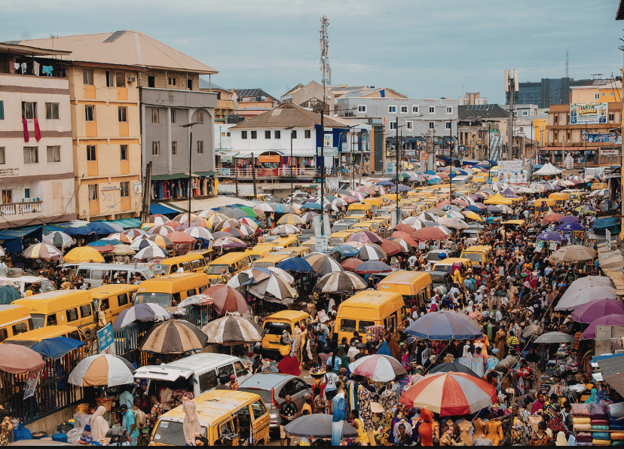
Hosted at Art Africa’s Sanaa Gallery within the Two Rivers Mall from September 7 to 30, 2025 the exhibition unfolds as a vivid, large-scale photographic meditation on Ìdúmọ̀tà, one of Lagos Island’s most visually charged urban hubs. Through her lens, Kayode transforms the chaotic Nigerian metropolis into a structured field of colour, pressure, movement, and symbolic density.
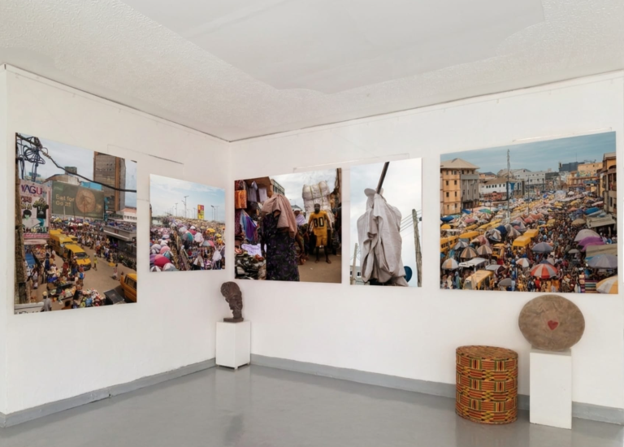
Walking into the gallery, the presentation immediately arrests you with its clean structural clarity. Mounted thoughtfully against the stark white gallery walls, the photographs form a measured, rhythmic dance of urban life: crowded markets, the iconic yellow danfo buses, layered tin rooftops, a sea of umbrellas, weathered facades, and bodies in constant motion.
Rather than isolating each frame, Kayode links them together as fragments of a single, sprawling urban symphony. It forces the viewer to traverse Ìdúmọ̀tà not just as a geographical location, but as a shifting emotional landscape.
Kayode’s genius lies in her ability to treat the city simultaneously as her subject and her architectural framework. In one frame, a dense swarm of market activity stretches beneath a canopy of commercial signage and tangled overhead cables, while the yellow buses punctuate the bottom of the scene like recurring notes in a musical score.
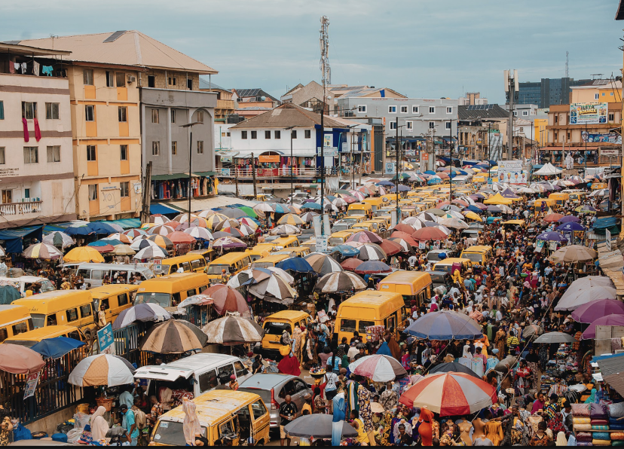
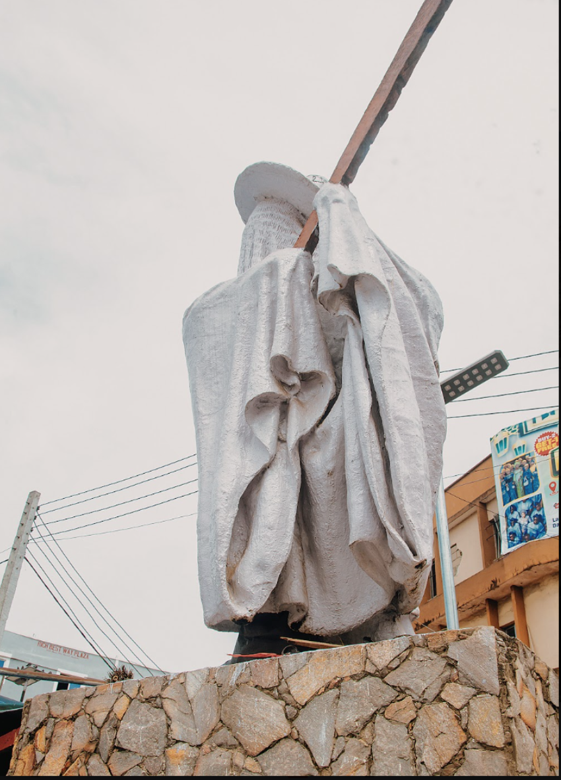
In another, open umbrellas cluster into vibrant fields of colour, masterfully turning urban congestion into an abstract pattern. Yet, amidst the noise, she finds quietude; a single veiled figure framed against the sky and surrounding utility poles offers a powerful moment of stillness within the larger intensity of the collection.
What Kayode delivers is far from a simplistic documentary of a city; it is a fine-art study of urban evolution. Using scale, repetition, and atmospheric lighting, she shows how the people of Ìdúmọ̀tà and the architecture they inhabit continually recreate one another.
The human figures here are never detached from their environment. They emerge through the dignity of labour, passage, and sheer presence—absorbed by the market’s density yet never losing their individual weight. The city is not a passive backdrop; it is an active, living force.
The exhibition’s title, People, Places, Phases, serves as a perfect roadmap for the viewer. “People” are represented not just by faces, but by their endurance, commerce, and tight proximity. “Places” materialize through the grit of the streets, historical monuments, and buildings shaped by time and human wear. “Phases” live in the constant tug-of-war between brightness and ruin, motion and stillness. Kayode’s Lagos is never static; it is always shifting, always under pressure, and aggressively alive.
The curation inside The Sanaa Gallery deepens this dialogue. The clean, modern architectural space allows the visual loudness of Lagos to breathe without overwhelming the audience. Furthermore, the strategic placement of sculptural objects and pedestal works creates a beautiful conversation between the flat photographic surfaces and material culture. These physical pieces subtly echo the textures and craft seen in the images, turning the gallery from a simple wall display into an immersive environment.
Color choice also carries significant weight in this body of work. The signature yellow of the transit buses, the sharp pinks and blues of market umbrellas, and the muted greys of concrete and sky are deliberate compositional tools. They guide the human eye through dense scenes that might otherwise trigger sensory overload, proving Kayode’s immense visual discipline.
Ultimately, People, Places, Phases succeeds because it refuses to reduce Lagos to a mere spectacle of third-world chaos. While the images are visually abundant, they look past the surface to ask deeper questions: How does a city hold onto its memory while constantly changing its shape? How do its people inhabit such immense pressure, and how can beauty emerge from compression and strain?
As a contribution to contemporary African photography, this exhibition stands as a thoughtful, visually assured triumph. It cements Funmilayo Kayode’s position as an artist deeply attentive to the formal possibilities of place, turning urban survival into images of enduring beauty.