On the Road in Ebonyi: A roving reporter’s diary of the renewed hope tour

BY BABAJIDE FADOJU
The sun was already assertive over Abakaliki when our convoy of media vehicles pulled out of the Government House gates.
I had covered infrastructure tours before, the kind where you drive for hours, see a billboard, shake hands with a contractor, and return with a press release.
But this renewed hope media tour of the south-east felt different from the first mile. There was an electricity in the air, the kind that comes not from speeches but from the sight of earth-moving equipment actually moving, of concrete pavements stretching beyond the horizon, and of local communities lining the roads to wave at us.
By the time we settled into our first stop, I knew I was witnessing something more than a routine inspection. I was watching a government determined to prove that a colonial-era dream, the Trans-Sahara highway, could finally be wrestled into reality.
Our team lead, Bayo Onanuga, set the tone at the flag-off. Standing under a makeshift canopy at the edge of the Onueke flyover site, he looked at the assembled journalists and said, “For me, this is like a second home. The last time I was here, I went to the Minister of Information.
We saw a lot of things that are happening. And on my own, as I am telling people, come and join me. I want to see something you’ve never seen in another part of Nigeria.” He wasn’t boasting. Over the next ten hours, I would see exactly what he meant.
THE ONUEKE FLYOVER: CONCRETE AMBITION
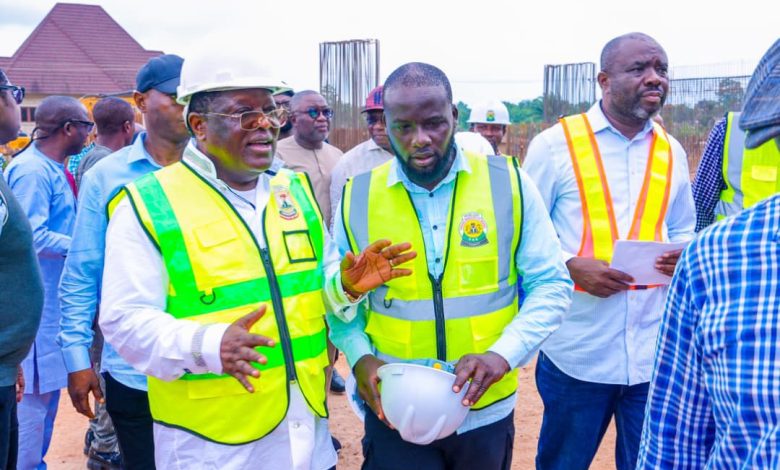
Our first technical stop was the Onueke flyover, a 90-metre structure that, when completed, will soar over the Trans‑Sahara highway. The minister of works, Senator Dave Umahi, stood before us, a tablet in one hand and a pointing stick in the other. He explained that this is a N35 billion federal project, designed to decongest one of the busiest trade corridors in West Africa.
“The Trans‑Sahara superhighway was the idea of the colonial masters,” Umahi said, his voice carrying over the rumble of nearby graders. “They were using this route for trading palm oil from the east, granite from the north, and even slave trading. That pathway has been a dream for 60 years. Today, President Bola Ahmed Tinubu, the man divinely called to do the impossible, is fulfilling that dream.”
He walked us to the edge of the foundation, where steel reinforcements jutted out like the ribs of a sleeping giant. “You see that?” he pointed. “Grade 40 concrete. Reinforced. This flyover will have a 2.2-kilometre road on both sides. By the end of May, the foundation work, about 60 percent of the project, will be completed. Before December, the entire flyover should be ready.”
I did the maths quickly: a 90-metre flyover flanked by more than four kilometres of approach roads, all to free up a highway that carries trade from Cameroon through Nigeria to the Sahel. That is not a bridge. That is a statement.
Umahi then turned to a larger canvas, the Calabar‑Ebonyi‑Benue superhighway. “Section one was originally an 118-kilometre single carriageway,” he said. “We reviewed it to 123.6 kilometres at a contract sum of N45 billion, and dualisation procurement is ongoing. Section two, from the Aboadi border through Benue and Kogi and ending in Nasarawa, has been awarded at N668 billion.”
He paused, letting the numbers settle. “We have attained about 28 percent completion in some parts, and we are not stopping because of rain. President Tinubu’s concrete road technology allows us to work through the wet season. That is the difference.”
CUTTING THROUGH HILLS TO SAVE LIVES
From Onueke, we drove towards Afikpo. The landscape changed from gentle savannah to steep hills, and the road narrowed into a winding valley that made even our experienced driver grip the wheel tighter. This, I learned, was the notorious Afikpo‑Amasiri stretch, a winding valley road that has consumed many lives over the decades. Here, the minister had a surprise for us. “We are doing the impossible,” he declared, gesturing at a massive cut through a rocky hill. “We are cutting through the hills so that this winding valley road will become a thing of the past. The cutting is more than 30 metres high.”
We got out and walked to the edge of the excavation. Thirty metres is about ten storeys. Below, workers were drilling and blasting in controlled sequences, while dump trucks hauled away debris.
“This is part of the Abakaliki‑Afikpo road,” Umahi said. “It will connect the Lagos‑Calabar Coastal Highway corridor from Cross River through Ebonyi to Abuja.” He added that the first section, from Ndibe Beach to the Ebonyi‑Benue boundary, covers 123 kilometres and costs about N454 billion. “It will feature reinforced concrete pavement, solar-powered streetlights, and dual-carriageway sections in strategic locations.” I asked a local farmer who had stopped to watch. “Before, we lost many people in that valley,” he said in Igbo. “If they finish this cut, my children will not fear the road again.”
OKPOSI COMMUNITY: TWO CONTRACTS, ONE CONCRETE VISION
By mid-afternoon, we arrived at the Okposi community, where the minister stopped to explain an intricate network of roads. “We are standing in the middle of two contracts,” he said, pointing in opposite directions. “The first contract traverses Ohozhara Local Government, goes down to Enugu State, and empties at the Enugu‑Butterkote expressway.
It is 43 kilometres on reinforced concrete, by a local contractor, Age‑Link. The contract sum is N34 billion.” He turned 180 degrees. “Backwards here is 51 kilometres, N53 billion, going from this community through Okwu and Abomege and extending to Ughette in Cross River State.”
He then made a remark that I scribbled down verbatim. “This concrete technology does not understand who an expatriate is and who is a local contractor. The moment you don’t do it well, it will show. And if you do it well, it will obey you. The method is the same; the principle is the same; the quality is the same. Grade 40 concrete.” He revealed that the first contract, towards Enugu, is about 90 percent completed, and the second, towards Cross River, is about 60 percent completed. “The contractors have been paid substantially, though they are still owed some. But they are working.”
Perhaps the most exciting news came next. “In the 2026 budget, we have the extension of this project to the Akanribiam local government area, which is where the new army depot that the president gave to the south‑east is located. This road will extend to that place.” A new army depot, a gift from Tinubu to the south-east, is now to be linked by a reinforced concrete road. That is not just infrastructure; that is strategic integration.
THE POLITICAL UNDERTONE: SENATORS PROMISE ELECTORAL PAYBACK
As the day wore on, the minister allowed himself a moment of political reflection. He quoted Senator Alli Ndume from the north‑east, who had said, “President, we are very happy. You don’t need to come and campaign.
North‑east people will pay you back in the 2027 elections.” Then he added his own words. “The people of the south‑east are very, very grateful to Mr President. All that our forefathers sought for inclusiveness, we have it now.” He reminded us that none of the opposition aspirants – he called them “aspirants” because “in some parties there are more than four aspirants, so no candidate has emerged” – can match what Tinubu has done for the region.
A journalist asked about the Lagos‑Calabar coastal highway. Umahi’s eyes lit up. “That is a 350-kilometre legacy project. Section one is 7.47 kilometres, six lanes, with a 25-metre drain in the middle. The bank that did the funding said it was undervalued.” He noted that Section two, 55 kilometres from the deep-sea port axis of Lagos, will feature the longest flyover in Africa to allow for traffic flow. “Components 3a and 3b are on track for commissioning by December.”
He then linked everything. “On the Lagos‑Calabar corridor, we have about 75 dams that we are designing with the Water Resources Minister for irrigation and power. We are mapping out millions of hectares for agriculture, and the corridor will connect to the Lagos‑Abidjan highway at the Parakou axis.”
EBONYI’S SECURITY MIRACLE AND SUBSIDY REMOVAL GAINS
Before we left, the Ebonyi state governor welcomed us with a bold claim. “Since I assumed office, there has not been a single kidnapping in this state.”
He backed it with a tour of projects spread across every local government area, including rural roads, primary health centres, and water schemes. The media team spoke to market women and farmers, who corroborated the security environment. But what they praised even more was the impact of the fuel subsidy removal. One woman, selling rice at the Afikpo market, told me, “At first, the pump price hurt us. But now our governor has money to fix our roads. We see the difference.”
That is the subtle but powerful story of the renewed hope agenda. The removal of subsidies, though painful, has increased monthly FAAC allocations to states. Ebonyi, like many others, has used that fiscal space to embark on projects that were previously stalled. The governor’s claim of “zero kidnapping” is not just about police work; it is about roads that bring economic activity, which in turn reduces desperation and crime. It is a virtuous cycle.
A REPORTER’S VERDICT: NOT JUST ASPHALT, BUT INCLUSION
By the time we headed back to Abakaliki, the sun was low and my notebook was full. I had counted three flyovers inspected, over 200 kilometres of concrete roads verified, two interstate corridors mapped, and countless quotes that could fill a manifesto. But the overarching theme was not just concrete and steel. It was inclusion. The south-east has long complained of marginalisation in federal infrastructure. Today, I saw with my own eyes that the Trans‑Sahara highway, the Calabar‑Ebonyi‑Benue link, the Onueke flyover, and the extension to the new army depot are not promises. They are either under construction or nearing completion.
Bayo Onanuga had told us at the start, “I’m not just here for the president but also to showcase what the governments have done.” By the end of the day, I believed him.
The renewed hope media tour is not a propaganda exercise; it is an evidence-gathering mission that lays the facts before the public. And the facts from Ebonyi are these: hills are being cut, concrete is being poured, and a colonial dream is finally being realised. Senator Umahi put it best when he said, “God brought President Tinubu. God will keep him. We are there together for the next five years.”
I have covered many infrastructure tours in my career. Most left me with scepticism and a folder of unanswered questions. This one left me with dust on my shoes, a head full of numbers, and a strange, unfamiliar feeling: hope. Not the cheap kind that evaporates at the next election.
The kind that comes from watching a 30-metre cut through a hill that has killed people for generations. The kind that comes from seeing a local contractor, armed with Grade 40 concrete, outworking expatriates. The kind that whispers, ‘Maybe, this time, Nigeria is actually building.’