By Ozolua Uhakheme
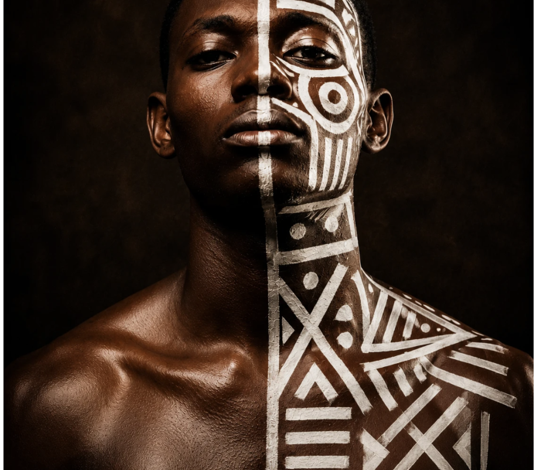
There is an immediate seduction to Miracle Okafor’s Bearer of Signs, but the photograph becomes more complicated the longer one looks.
Okafor is a visual artist whose practice fuses fine art photography and painting, using the photographed body as both subject and surface.
Shown at the Bradford African Festival of Arts (BAFA) exhibition at the Small Hall, University of Bradford, on August 3, 2026, Bearer of Signs presents a young Black man against a near-black field, his torso bare and his gaze unwavering.
A vertical white line divides his body almost exactly in two. On one side, skin remains largely uninterrupted; on the other, face, neck, shoulder and chest are overtaken by an intricate vocabulary of circles, stripes, crosses, dots and angular forms.
The division is so precise that it initially appears to offer a simple binary: marked and unmarked, exposed and inscribed, natural and constructed. Okafor complicates that reading. The line separating the two halves does not stop at the face.
It travels from the forehead across the bridge of the nose, interrupts the lips and continues through the neck and torso. What might otherwise have functioned as decoration becomes the organising principle of the portrait, turning the body into a visual field upon which competing ideas of identity and representation can coexist.
Okafor uses white pigment to reorganise the sitter’s anatomy into a graphic composition. Circles gather around one eye, parallel lines descend along the cheek, while crosses, triangles and repeated marks spread across the neck and shoulder. The signs suggest the structure of a visual language without offering the viewer an obvious means of translating it. This is crucial to the photograph’s effect. The marks appear meaningful, but Okafor resists explaining precisely what they mean.
The title intensifies this ambiguity. To “bear” signs is both to display and to carry them. The wording raises questions about whether such signs are chosen, inherited, accumulated or imposed. Okafor leaves those possibilities unresolved, allowing the work to operate less as a statement about a fixed identity and more as an exploration of the ways identity becomes visible, interpreted and projected upon.
The sitter himself resists easy interpretation. His head is held upright and his eyes meet the viewer directly. There is little vulnerability in his expression and no obvious attempt to perform emotion for the camera. This directness prevents the painted body from becoming simply an object of visual fascination. The viewer may inspect the markings, but the sitter retains an unmistakable sense of agency. He is being looked at, yet his gaze makes clear that he is also looking back.
That exchange is central to the psychological force of Bearer of Signs. Okafor presents an abundance of visual information while withholding the certainty that such information might normally promise. The markings invite interpretation, but the portrait refuses to confirm whether the meanings assigned to them belong to the subject, the artist or the viewer. The work therefore becomes as concerned with the act of looking as with the figure being observed.
Technically, Okafor exercises considerable restraint. The background recedes into deep brown and black tones, removing almost every competing element from the frame. Light moves selectively across the sitter’s forehead, cheekbones, lips, collarbones and chest, giving the skin an almost sculptural density. Against these warm tonal variations, the white pigment arrives with graphic insistence. Painting and photography are not treated as separate processes here; each reshapes how the other is seen.
This relationship is particularly evident in the contrast between the two sides of the body. On the largely unpainted half, light emphasises skin texture, contour and tonal variation. On the marked half, those same physical surfaces are reorganised through geometry. The eye moves between flesh and line, photographic detail and painted intervention. Neither side ultimately dominates. What appears at first to be a sharply divided portrait gradually reveals itself as a study in coexistence.
Even the central white line performs this contradiction. It is the composition’s clearest boundary, yet it also binds the two halves together. The same face, neck and torso continue across it. Okafor consequently avoids reducing the photograph to an obvious metaphor of “two identities.” The work is more persuasive when understood as an exploration of multiplicity: the possibility that memory, experience, inheritance, self-presentation and the perceptions of others can occupy a single body simultaneously.
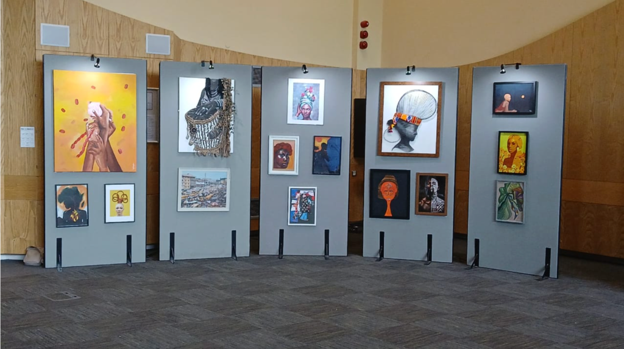
Within the setting of the Bradford African Festival of Arts, the photograph also enters a wider conversation about contemporary African artistic expression, heritage and cultural memory. Yet Bearer of Signs does not depend on an explanatory landscape, costume or narrative setting to establish its relationship with those concerns. Okafor keeps the frame deliberately spare. The body occupies almost everything, concentrating attention on surface, gaze and the uneasy process through which visual signs acquire meaning.
The work’s references to African visual traditions remain suggestive instead of prescriptive. Okafor does not provide a simple cultural code through which each circle, stripe or geometric form can be decoded. That restraint protects the photograph from becoming an illustration of heritage. Instead, cultural memory appears as one possible layer within a more complex meditation on how individuals carry signs of belonging and how those signs are interpreted from outside.
The photograph’s direct gaze finally becomes as important as its painted surface. The sitter looks back with enough assurance to prevent the image from being consumed solely for its symmetry, pattern or beauty. His presence introduces a question that lingers beyond the initial visual impact: how much can we know about a person from the signs we see on them? The closer the viewer looks, the less certain any single interpretation becomes.
This uncertainty is where Bearer of Signs finds its strength. Okafor creates conceptual density with relatively few elements: a body, a dark ground, controlled light, white pigment and an unwavering gaze. His fusion of fine art photography and painting enables the body to function simultaneously as portrait and surface, recognisable person and field of signs.
In Bearer of Signs, Miracle Okafor produces an image that is visually commanding without relying on spectacle. Pattern, symmetry and light may first arrest the eye, but the work endures because it refuses to let those signs define the person carrying them.
The sitter remains present, self-possessed and ultimately resistant to complete interpretation. We can see the signs clearly. What they cannot fully contain is the man beneath them.