BY OZOLUA UHAKHEME
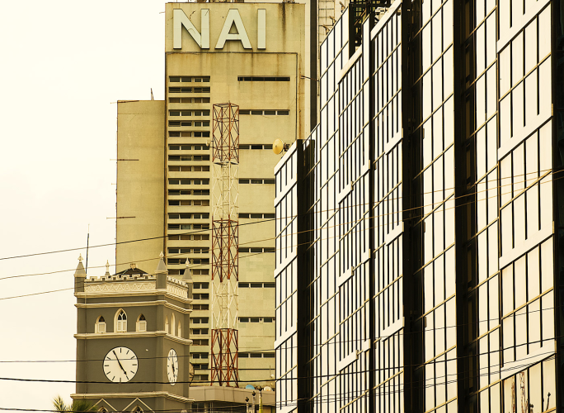
Uche Rita Okolie’s photograph, No Time, currently showing at the Sanaa Gallery inside Nairobi’s Two Rivers Mall, Kenya, is a profound study of urban pressure.
Presented as part of the group exhibition No Time to Say No Time: Lagos Island in Motion running from 25 November 2024 to 15 December 2024, the image captures something deeper than mere dramatic chaos.
Instead, it frames the quiet, relentless friction of a city growing upwards, heavily wired, deeply layered, and moving far too fast for the naked eye to process comfortably.
The lens focuses on a slice of Lagos Island where architecture feels less like shelter and more like a visual argument. Rising just left of the centre is a massive building bearing the blunt letters “NAI”. Its stained concrete façade carries the unmistakable weight of time, bureaucracy, and institutional history. Yet, sprouting like metallic weeds from its roof and the skyline behind it is a dense thicket of telecom masts and antennae.
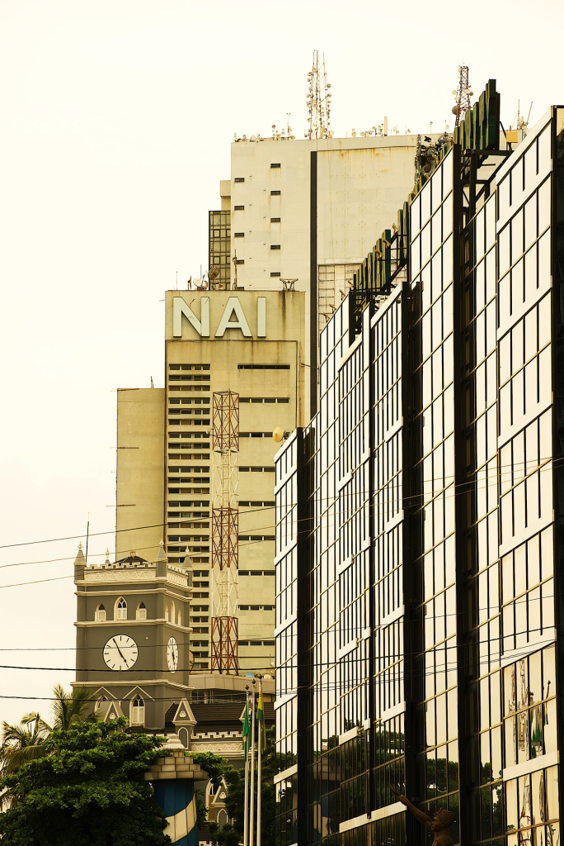
Directly to the right, a newer glass-fronted structure slices sharply through the frame. Its rigid, black-and-white geometry projects a modern, corporate authority; polished, reflective, and entirely impersonal. Tucked beneath these giants sits an old clock tower, partially swallowed by trees and a web of overhead cables. Its face remains visible, but it is clearly overwhelmed by the towering structures competing for space around it.
This is precisely where Okolie’s work becomes compelling. She is not merely documenting buildings; she is exploring how these structures jostle for attention, stacking different eras, social statuses, and human ambitions into a single view. Rather than presenting Lagos Island as a pretty skyline to be admired from a distance, Okolie treats it as a dense urban text where concrete, glass, clock faces, and cables press tightly against one another.
The title, No Time, gives the piece its critical edge. While time is literally present in the clock tower, it also forms the very structure of the photograph. Older civic architecture is pinned beneath institutional blocks, which are in turn dwarfed by modern communication infrastructure.
Meanwhile, the sleek glass façade on the right interrupts and dominates everything else. This is not a neat historical timeline; it is time stacked unevenly. Lagos Island does not clear away its past to make way for the future; it absorbs, covers, and crowds its history together.
The composition thrives on vertical tension. The eye is pulled upward from the clock tower to the “NAI” building, and higher still to the telecom masts, before being sharply deflected by the reflective grid of the corporate building on the right.
It leaves the viewer with the distinct sensation of looking at a city that simply refuses to rest. Even the messy wires cutting across the lower half of the frame act as lines of interruption, proving that urban space is rarely neatly arranged. In Lagos, the city speaks through its obstructions.
Interestingly, there are no people in this shot. In most depictions of Lagos, the human element—traders, commuters, and bustling crowds—supplies the energy. Here, Okolie purposefully removes the human body from the centre, allowing the city’s infrastructure to stage its own restless performance. The buildings become the primary actors.
The masts hint at constant connectivity and surveillance, the clock tower points to a fading public order, and the glass façade speaks of capital and high aspiration. The city has not stopped just because the camera shutter clicked; it is moving forcefully through its own systems.
There is also a subtle battle happening between memory and modernity. The clock tower, with its older architectural design, feels ceremonial—a quiet reminder of a past civic order. Yet, compressed by the surrounding structures, it has lost its dominance.
Refreshingly, Okolie avoids cheap nostalgia. She does not mourn an older Lagos with sentimental tears. Instead, she shows how memory actually survives under pressure: partly hidden by trees, crossed by wires, and overshadowed by new symbols of power.
Colour plays a vital role in unifying the scene. Washed in warm, yellowish tones, the photograph gives the buildings a dusty, sun-stained quality that evokes the actual climate, heat, and age of Lagos. This warmth prevents the image from feeling like a cold architectural blueprint. Even the rigid, reflective glass building on the right, which introduces a cooler corporate logic, is caught in this same golden light. Okolie forces the city’s various surfaces to share the same atmosphere, even when they belong to completely different economic worlds.
As a piece of fine art photography, No Time succeeds because it prioritises tension over simple description. It does not just ask us to recognise Lagos Island; it challenges us to read it.
It forces us to question the relationship between the old public clock and the new telecom mast, between concrete and glass, and between a city’s historical identity and its aggressive hunger for expansion.
Within the broader context of the Lagos Island in Motion exhibition, this photograph serves as a anchor. It illustrates the title’s urgency not through traffic jams, but through architecture under acceleration. Okolie’s triumph lies in her ability to make Lagos Island look simultaneously familiar and unstable. In her hands, it becomes a restless, living monument to urban urgency, a city with no time to explain its contradictions, and no time to pause before reinventing itself.