BY BABAJIDE FADOJU
The renewed hope media Tour of Abia state has uncovered a story of transformation that deserves to be told.
From the 67‑kilometre Umuahia–Uzuakoli–Akara–Ohafia road, which was in a state of decay for almost two decades, to the renewed hope housing estates rising in Umuahia and Onuinyang
Bende, and the ongoing work on federal corridors like the Enugu–Port Harcourt expressway, Abia is witnessing an infrastructure renaissance that few could have predicted just a few years ago. The evidence is no longer anecdotal; it is visible, verifiable, and increasingly difficult to ignore.
THE ROAD THAT UNITES 20 COMMUNITIES
The 67‑kilometre Umuahia–Ohafia road is a testament to what happens when a state government prioritises connectivity. Before this administration, the road was almost impassable, a decaying relic that had been abandoned for close to two decades.
Communities along the corridor were cut off from markets, agricultural produce rotted before it could reach buyers, and minerals that could have driven local economies remained trapped in the earth. The state government, understanding the economic and social benefits of the road, awarded it to three construction companies, who worked simultaneously and delivered the project in record time. Today, over 20 communities are linked, agricultural produce moves freely, and social connections that were once severed have been restored.
THE ECONOMIC LOGIC OF STREETLIGHTS
During the tour, a curious observation was made. Upon entering Abia state, the delegation noticed streetlights along the road. The honourable commissioner for works explained that the streetlights are not a contradiction; they are a deliberate investment in economic activity.
Streetlights extend the hours of commerce, improve security, and signal to investors that the state is serious about creating an enabling environment. Communities that were once dark and dangerous after sunset are now illuminated, allowing businesses to operate longer and residents to move freely. This is infrastructure with a human face.
RENEWED HOPE HOUSING: BUILDING FOR THE FUTURE
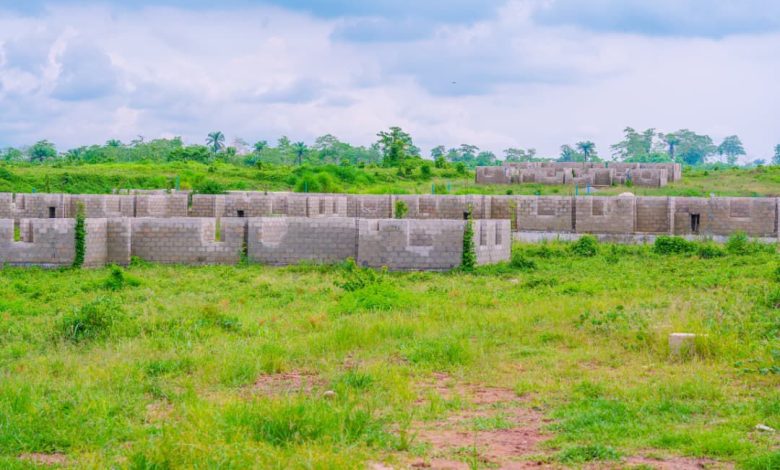
The renewed hope housing estates in Abia are another critical piece of the puzzle. In Umuahia, 1,200 housing units are being built, with the first phase targeting low and mid‑income earners. In Onuinyang Bende, facilitated by Benjamin Kalu, deputy speaker of the house of representatives, 180 units are proposed.
These are not just houses; they are the foundation of a new social contract between the government and its citizens. President Tinubu has been clear that the renewed hope housing agenda is about more than just roofs; it is about restoring dignity, creating jobs, and stimulating local economies. And the numbers bear this out: almost 1,648 Nigerians have already benefited from mortgages, with close to N218 billion disbursed.
SIMULTANEOUS DEVELOPMENT ACROSS NIGERIA
What is perhaps most significant about the Renewed Hope housing projects is that they are happening simultaneously across every geopolitical zone. In Kano, houses are at about 60 percent completion. In Abuja and other states, they are at 45 percent.
In Abia, progress is at about 35 percent. This is not a project for one region or one tribe; it is a national programme. As one official put it, “The vision is that it does not bear tribal marks or ethnic marks. So long as you are part of a Nigerian state, development will reach you.” That is a powerful statement of intent, and it is being backed by action.
THE FEDERAL-STATE PARTNERSHIP
The Abia inspection also highlighted the synergy between federal and state governments. While the Umuahia–Ohafia road is a state project, it complements federal efforts on corridors like the Enugu–Port Harcourt expressway and the Owerri–Abia–Imo federal road.
The federal government provided the groundbreaking for the renewed hope housing estates, and the state government has executed its own projects to enhance connectivity.
This is the partnership that the renewed hope agenda envisions: federal policy enabling state execution, and the people reaping the rewards.
Abia state, like Enugu and Ebonyi before it, is demonstrating that the south‑east is no longer an afterthought. It is a priority.
The road that connects 20 communities, the streetlights that illuminate commerce, the housing estates that restore dignity, and the federal corridors that link the region to the rest of the country are all evidence of a government that is serious about development.
The renewed hope agenda is not a slogan; it is a strategy. And in Abia, the strategy is working.