Architecture in limbo: Olakunle Bolawa photographs Calabar’s forgotten Marina

By Ozolua Uhakheme
Once central to Nigeria’s colonial trade routes, the Marina complex in Calabar now stands suspended between history and neglect.
Olakunle Bolawa’s restrained photographic series examines what remains when architecture outlives the systems that shaped it.
Olakunle Bolawa’s Abandoned series, shown at Calabar Gallery, Cross River from 3-28 February 2025, turns its attention to a stretch of Calabar that once functioned as a gateway between Nigeria and the wider world.
The Marina complex, built during the colonial period, served as a hub of import, export and administrative power. Today, it sits quietly by the water, neither restored nor erased, its presence tolerated rather than acknowledged. Bolawa approaches this site without nostalgia or outrage. Instead, he looks steadily, allowing the buildings to speak in their own restrained register.
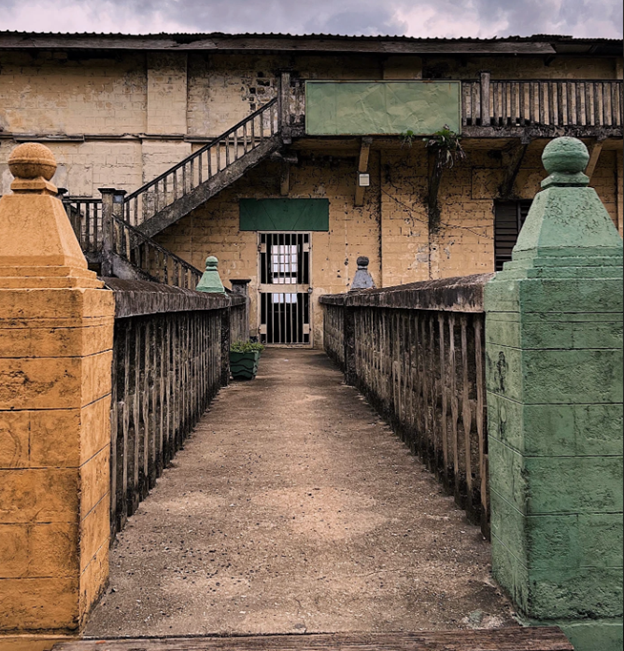
These photographs are notable for their composure. Bolawa favours frontal viewpoints, symmetrical framing and a subdued palette that avoids the drama often associated with images of decay.
There are no exaggerated contrasts or theatrical shadows. Rust, moss and weathered stone appear as facts rather than effects.
The buildings do not collapse into ruin; they endure, visibly worn but structurally intact. This sense of suspension of things neither alive nor finished, gives the series its quiet force.
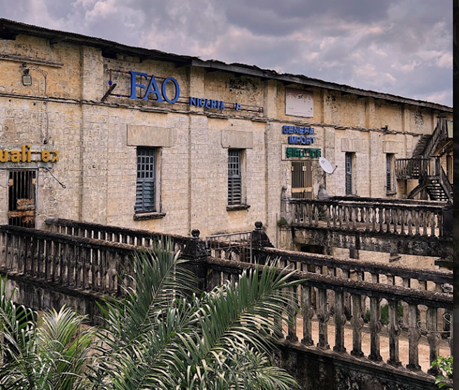
In one of the key images, the former FAO Nigeria building stretches across the frame beneath a heavy, unsettled sky. Its signage remains legible, stubbornly intact, hovering above barred windows and walls stained by time.
Bolawa’s camera sits at a slight remove, allowing the structure to read as a witness rather than a monument. The image resists grandeur. What it offers instead is a sense of stalled purpose: a building that still stands, but no longer knows why.
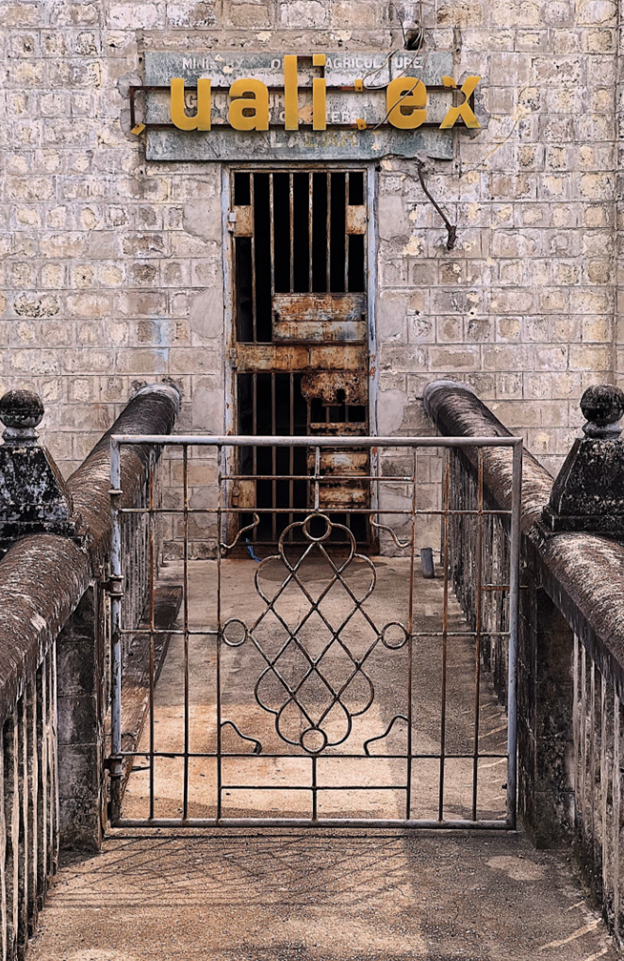
Elsewhere, Bolawa photographs the entrance to the Quali-ex building head-on, transforming a rusted gate into a kind of accidental sculpture. Layers of peeling paint, corrosion and improvised repairs accumulate across the surface, compressing decades into a single plane. Above the door, faded lettering once signalled authority and access.
Now it lingers as a fragment, caught between meaning and irrelevance. The frontal composition recalls the typological discipline of Bernd and Hilla Becher, but where their work sought systematic classification, Bolawa’s images linger on what cannot be categorised: wear, neglect, and emotional residue.
Perhaps the most quietly affecting photograph in the series depicts the General Import Structure. Barred double doors are locked beneath fading signage, closure rendered with bureaucratic finality. At the bottom edge of the frame, a stray cat lies resting, seemingly indifferent to the history looming above it.
The detail is small, almost incidental, yet it subtly shifts the image’s centre of gravity. Life continues, Bolawa suggests, even as institutions stagnate. The presence of the animal neither sentimentalises nor redeems the scene; it simply complicates it.
What distinguishes Abandoned from much contemporary ruin photography is Bolawa’s refusal to aestheticise collapse. His restraint is deliberate. By avoiding spectacle, he allows the architecture to assert its own authority. These buildings are not backdrops for metaphor; they are the subject.
The Marina emerges as a contested archive, a place heavy with memory but excluded from preservation. Unlike work that fetishises decay as beauty, Bolawa’s photographs interrogate stasis. These structures have not been destroyed; they have been neglected. The difference matters.
Within a Nigerian context, Bolawa’s work enters into conversation with photographers such as George Osodi and Uche Okpa-Iroha, whose practices have similarly examined infrastructure as a measure of political and social will.
Internationally, the series resonates with broader postcolonial explorations of architecture and memory, recalling artists such as Zineb Sedira, whose engagement with maritime sites treats history not as spectacle but as embedded infrastructure.
Abandoned is not concerned with ruins as romantic symbols of the past. It is concerned with responsibility, with what societies choose to maintain, what they allow to decay, and what they quietly forget. Bolawa does not ask the viewer to mourn the Marina.
He asks us to acknowledge it, to recognise abandonment not as an end point, but as an ongoing condition shaped by neglect and selective remembrance. This is work that insists on looking closely, and on staying with what remains.