

Beyond spectacle: Esther Okon’s carriers of the everyday at the Abuja photo festival

By Ozolua Uhakheme
Presented within the curatorial framework of “Interrogating Barriers to Visual Expression”, Esther Okon’s Carriers of the Everyday stands out as one of the festival’s most conceptually grounded engagements with the theme.
Exhibited in Abuja from 26-28 October 2023, the series reflects on everyday visual expression in Lagos Africa’s most populous city, where informal labour shapes both the rhythm and the image of urban life.
Rather than staging overt confrontation or protest, Okon approaches barriers as conditions embedded within visibility itself: economic precarity, informal labour, and gendered endurance emerge as quiet but persistent obstructions to full social recognition.
The strength of the series lies in its refusal of spectacle. Although the photographs risk slipping into ethnographic familiarity, street vendors and market scenes long established within documentary traditions, Okon resists the climactic moment. Nothing erupts into drama; no decisive event punctures the frame.
Instead, the images dwell in the persistent present of work. This temporal flatness becomes the conceptual engine of the exhibition. By denying spectacle, Okon interrogates a core barrier to visual expression: the expectation that marginalised lives must perform extremity in order to command attention.
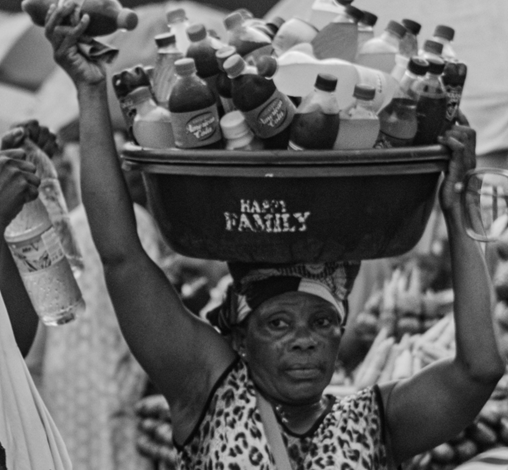
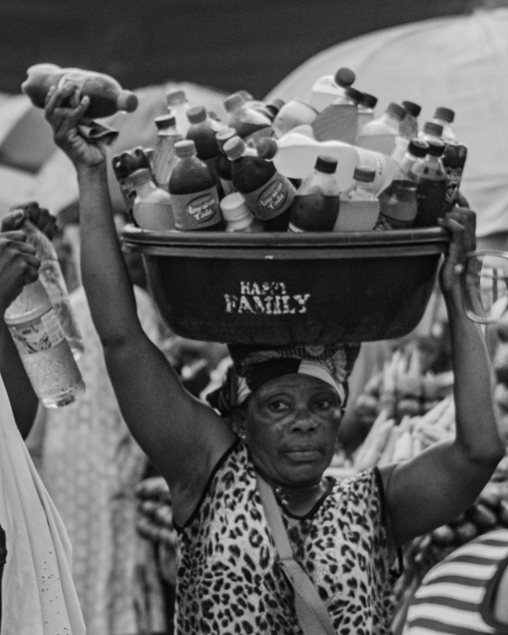
The opening black-and-white photograph establishes the series’ critical thesis. A vendor raises her arms to balance a basin of soft drinks; in Okon’s framing, the gesture transforms the basin into something resembling a crown, an accidental monument to informal capitalism.
The monochrome palette operates less as nostalgia than as equalizer. By stripping the goods of their chromatic seduction, Okon redirects focus towards the body posture, muscle memory, strain. Commercial colour recedes; endurance becomes central. Here, the barrier is not invisibility but misrecognition. The photograph demands that viewers reconsider what constitutes value within the frame.
A seated fish vendor introduces a counterpoint of stillness. Labor becomes meticulous rather than mobile. Carefully stacked smoked fish echo sculptural accumulation, their repetition generating a restrained, almost minimalist rhythm.
Yet unlike the industrial neutrality associated with Western minimalism, this repetition is saturated with survival. Okon subtly destabilises inherited sculptural hierarchies by presenting market arrangement as vernacular installation. The barrier to visual expression here resides within art history itself whose canonical categories have often excluded such embodied, utilitarian aesthetics from serious formal consideration.
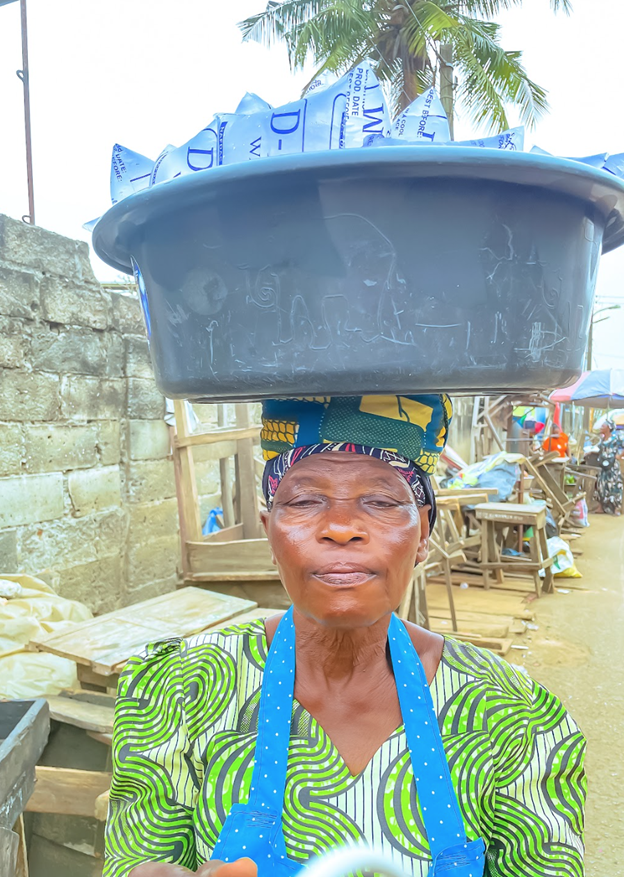
The emotional and formal centre of the series emerges in the portrait of an elderly sachet-water carrier. The frontal composition resists romanticisation through its directness. The oversized basin, nearly architectural in scale, compresses the subject’s vertical space while amplifying her presence within it.
The tension between fragility and endurance becomes palpable. Time is not abstract; it is visibly carried. Within the festival’s thematic context, the image interrogates age as a barrier to visibility challenging the privileging of youth, dynamism, and spectacle over accumulated resilience.
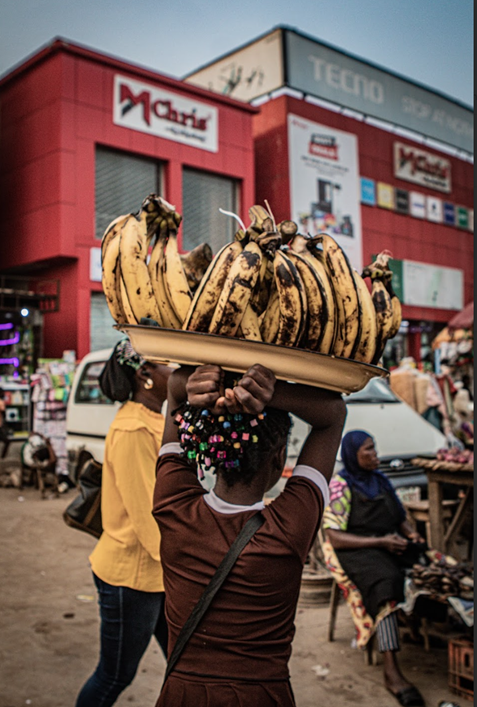
Movement re-enters with the plantain hawker, photographed from behind. This back-facing posture introduces anonymity and multiplicity. She is less an individualised portrait than a recurring figure one of many carriers inhabiting the urban periphery.
A red commercial building in the background subtly invokes formal retail systems, situating the hawker within a visual dialogue about parallel economies. Okon suggests that barriers are structural rather than personal; the informal sector does not exist outside modernity but alongside it, frequently unacknowledged despite its indispensability.
The smoked animal skin market scene shifts attention from carriers to exchange. A reaching arm, suspended mid-transaction, becomes the exhibition’s only overt gesture of relationality.
Carrying is shown to culminate not in possession but in circulation. Labor finds meaning in transfer. Visibility, in this moment, is reframed as relational expression resides not solely in the individual body but in the network of gestures binding community and commerce.
FORMAL AND CONCEPTUAL ASSESSMENT
Carriers of the Everyday succeeds most compellingly where it resists sentimental documentary tropes. Okon does not frame her subjects as passive emblems of hardship. Instead, goods often threaten to eclipse the body, only for posture, gaze, or gesture to reclaim compositional authority.
This oscillation produces productive discomfort. The viewer cannot settle into reading the photographs purely as sociological documentation, nor can they retreat into detached aesthetic appreciation. The work insists on ethical attention.
If a limitation emerges, it is spatial rather than conceptual. The market environments remain consistently dense and grounded. Moments of ruptured transitional roads, empty thresholds, spaces of pause might have intensified the metaphor of carrying as passage across visible and invisible barriers.
Nevertheless, the series makes a persuasive contribution to the festival’s inquiry. Okon demonstrates that barriers to visual expression are not only institutional or political; they are embedded within habits of looking. Informal labour, often peripheralized in economic discourse and visual culture alike, is repositioned as central to urban modernity’s aesthetic and structural formation.
CLOSING REFLECTION
Within the context of the Abuja Photo Festival, Carriers of the Everyday reads as a sustained study in balance, physical, economic, and representational. The series does not resolve the tension between visibility and invisibility. Instead, it allows its subjects to remain in motion, suspended between burden and monument. In doing so, Esther Okon offers a quiet yet incisive meditation on what and who gets to be fully seen


