Tunji Alausa, minister of education, says President Bola Tinubu is transforming proceeds of crime into investments that improve student welfare, strengthen learning infrastructure and expand access to quality education across Nigeria.
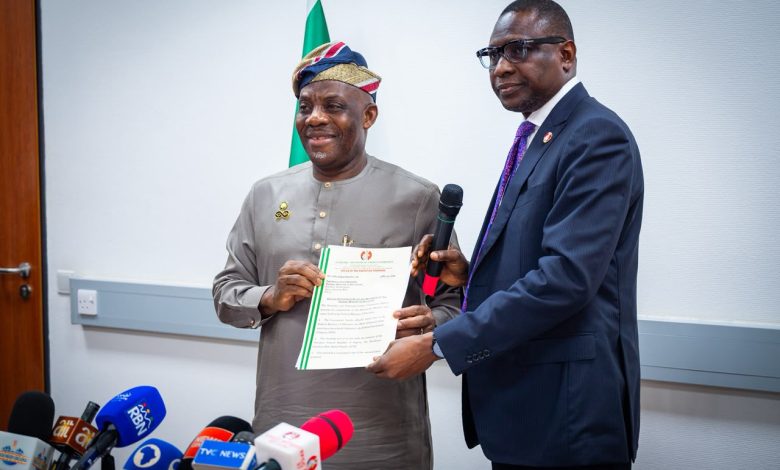
Alausa spoke on Tuesday during the handover of recovered assets by the Economic and Financial Crimes Commission (EFCC) to the federal ministry of education in Abuja.
The recovered assets include 501 double-decker bed frames, 939 mattresses and 12 wooden beds with mattresses, which will be distributed to federal unity colleges across the country.
According to the minister, the asset recovery programme reflects the Tinubu administration’s commitment to ensuring that resources recovered from criminal activities are redirected to projects that directly benefit Nigerians, particularly children and young people.
He said the initiative demonstrates the government’s resolve to reinvest recovered public assets in critical sectors, with education remaining a top priority.
Alausa described education as central to Tinubu’s vision of building a $1 trillion economy through sustained investment in human capital development.
He said converting recovered assets into educational resources reflects a deliberate policy of turning proceeds of crime into opportunities that improve learning outcomes and secure a better future for Nigerian students.
The minister added that the education sector has become one of the biggest beneficiaries of the federal government’s asset recovery efforts.
He recalled that Tinubu had earlier approved the conversion of a forfeited university facility into the Federal University of Applied Sciences, Kachia, instead of allowing the property to be sold.
According to Alausa, the university has already enrolled more than 3,000 students in programmes covering applied sciences, engineering, nursing, health sciences and other critical fields.
He said the newly recovered assets would significantly improve accommodation and welfare for students in colleges and other educational institutions nationwide.
Alausa also commended Ola Olukoyede, chairman of the EFCC, for strengthening public confidence in the anti-graft agency through professionalism, adherence to the rule of law and sustained efforts against corruption, procurement fraud and cybercrime.
Earlier, Olukoyede said the assets were recovered during Operation Eagle Flush, one of the commission’s largest cybercrime operations.
He said the operation, conducted towards the end of 2024, led to the arrest of about 792 suspects, including foreign nationals, who were investigated, prosecuted, convicted and repatriated after serving their prison terms.
The EFCC chairman said the restitution was carried out in line with the Proceeds of Crime Act and the federal government’s commitment to ensuring that recovered assets are transparently deployed for national development.
Olukoyede said children and young people are among the greatest victims of corruption and financial crimes, making it appropriate for them to benefit from assets recovered from criminal enterprises.
He also highlighted previous interventions by the commission in the education sector, including the transfer of the forfeited university facility that now houses the Federal University of Applied Sciences, Kachia, and the deployment of recovered proceeds of crime as part of the seed funding for the Nigerian Education Loan Fund (NELFUND).
According to him, about 1.4 million students have already benefited from the student loan scheme through tuition support and monthly upkeep allowances, easing financial pressures that often expose vulnerable youths to cybercrime and other financial crimes.
The handover was formalised through the signing of a deed of release by representatives of the EFCC and the federal ministry of education, including Abel Olumuyiwa Enitan, the ministry’s permanent secretary.
Alausa assured Nigerians that the recovered assets would be distributed transparently and equitably to unity schools across the country to improve student welfare, accommodation and learning infrastructure.