Forensic analysis stalls Emefiele’s ‘$4.5bn fraud’ trial over procedural dispute

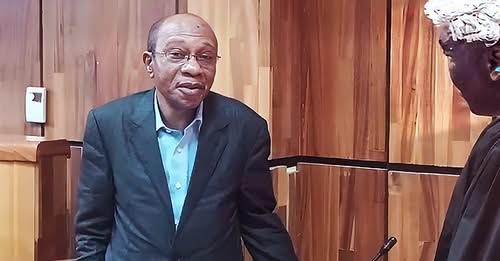
The forensic examination of a mobile phone and WhatsApp chats in the $4.5 billion fraud trial of Godwin Emefiele, former governor of the Central Bank of Nigeria (CBN), suffered a setback following disagreements between prosecution and defence teams.
The issue came up on Tuesday before Rahman Oshodi, the presiding judge at the Ikeja special offences court.
The examination, which was to be conducted jointly by experts from both sides, failed to proceed due to disputes over how the process should be executed.
Emefiele is facing a 19-count charge bordering on alleged gratification and corrupt demands, while his co-defendant, Henry Omoile, faces a three-count charge of unlawful acceptance of gifts by agents. The charges involve a total of $4.5 billion and N2.8 billion.
At the resumed hearing, Olalekan Ojo, a senior advocate of Nigeria (SAN), lead counsel to Emefiele, accused the Economic and Financial Crimes Commission (EFCC) of obstructing the court-ordered forensic process on two occasions.
The judge had, on September 15, ordered that the mobile device marked “iPhone 2”—and its WhatsApp contents—tendered as evidence by the EFCC, be subjected to scientific analysis by experts representing both sides.
Ojo told the court that despite the presence of both parties and the court registrar on September 24 and 25, the exercise could not take place.
He said EFCC officials initially claimed the phone could not be fully exposed to the joint forensic team.
On the second day, he added, the anti-graft agency’s representatives failed to produce the device when Apple’s expert demanded access.
Ojo argued that unrestricted access was necessary for a credible examination and asked the court to issue a fresh order compelling compliance.
In response, Rotimi Oyedepo (SAN), counsel to the EFCC, said the defence’s expert examination was flawed, noting that it breached standard forensic procedures.
He alleged that the expert lacked a physical laboratory or verifiable office and conducted parts of the analysis online, potentially compromising data integrity.
“The implication of their request is that Exhibit E could be altered. The data might auto-sync, compromising its authenticity,” Oyedepo said, adding that the iPhone remained in flight mode and untampered with.
The defence, however, urged the court to suspend further proceedings until the forensic process was concluded, insisting that the WhatsApp chats were central to their case.
Justice Oshodi directed the EFCC to file its forensic report within 24 hours and ordered both parties to adopt electronic service of documents to prevent further delays.
The case was adjourned to October 8 for continuation of trial.