Where the future already lives: A day with Mass Communication students at Babcock University

By Olufemi Ogunyejo
The journey to Babcock University on Tuesday, March 31, 2026, began with a smooth drive along a well-connected road network, accompanied by cool and refreshing weather conditions that set a calm tone for the day ahead.
It was one of those mornings where the elements aligned in quiet cooperation, making the journey not just a movement across distance but a gradual transition into purpose.
With Mr. Ayano David Adeniyi at the wheel, whose professionalism and steady navigation ensured a seamless trip, the experience was both comfortable and reflective even before arrival.
As the road gently led into the university environment, a noticeable shift occurred; the noise of the outside world gave way to a space that felt intentionally ordered. It became immediately clear that this was not just a campus; it was a statement.
Neat lawns stretched with deliberate care, walkways were impeccably clean, and buildings stood with a calm dignity that reflected discipline at every level. Then came the students—well-dressed, composed, and purposeful. There was something striking about them, not merely in appearance but in carriage. They carried themselves with a sense of identity, as though they understood that how they present themselves is itself a form of communication. In a field like Mass Communication, that realization is profound.
As I walked through the campus, exchanging greetings and observing interactions, it became evident that this visit would not be a one-sided engagement. Rather, it was already unfolding into a narrative—one of culture, structure, and quiet excellence, carefully nurtured within an academic environment shaped by distinguished scholars.
This atmosphere reinforced the vision of the university leadership under the Vice-Chancellor, Prof. Afolarin Olutunde Ojewole, whose commitment to bridging the gap between the gown and the town continues to create meaningful platforms where theory meets practice.
In the same vein, I must acknowledge with sincere gratitude Dr. Samuel Okere, whose nomination and belief in my capacity and competence made my presence at this engagement possible. His confidence was not only affirming but also a reminder that professional journeys are often sustained by those who recognise potential and create opportunities for its expression.
The engagement itself, themed “Media Conglomeration in the Digital Age: Implications for Mass Communication Specialisations in a Digital Age,” was more than an academic exercise; it was a living reflection of where the future already lives, right within the minds and realities of the students gathered in that hall.
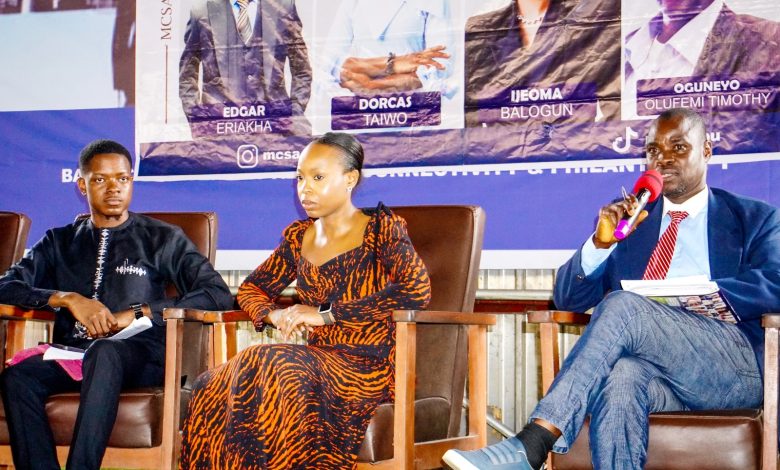
At the forefront of this engagement was Dorcas Taiwo, the main guest speaker, whose keynote address did more than introduce the theme; it cleared the path for every other contribution that followed. With clarity, depth, and strategic insight, she framed the conversation in a way that made the complexities of the digital media ecosystem both accessible and compelling.
The occasion was further enriched by the presence of Dr. Joshua Suleiman, whose remarks underscored the institution’s commitment to aligning academic learning with industry realities.
Subsequently, contributions from Edgar Eriakha and Ijeoma Balogun added practical industry depth to the discourse, reinforcing the central idea that media today is no longer confined to single platforms but exists within an interconnected digital ecosystem.
By the time it was my turn to engage, the atmosphere in the lecture hall had shifted into one of heightened curiosity. The room was already alive with conversations, thoughtfully coordinated by the student leadership of the Mass Communication Students Association. As the session commenced, that energy did not dissolve into silence but transformed into focused attention.
Addressing the students, particularly the print students of the department, I was reminded that even within the realities of media conglomeration in the digital age, foundational disciplines remain not only relevant but essential. It was within this context that I introduced a simple yet profound premise: “…we are no longer merely discussing media evolution; we are confronting a world that has already moved….”
That moment captured the essence of where the future already lives—not in distant projections, but in present realities.
Consequently, the discussion unfolded into an exploration of how everything has transitioned—communication, commerce, education, relationships, and even money. From physical exchanges to digital systems, from cash transactions to cryptocurrencies like Bitcoin, and from traditional banking structures to fintech platforms such as Paystack and Flutterwave, it became increasingly clear that the shift is no longer approaching; it has already happened.
As the conversation deepened, key concepts were clarified to provide structure to this evolving reality. Media was no longer presented as just a channel but as a system of influence; conglomeration as control across platforms; the digital age as a new mode of existence; and implications as signals demanding strategic response. In that moment, the students were not just learning; they were recognising themselves within the system.
Building on this, we traced the journey from the printing press to platform dominance, highlighting how power has shifted from those who produce content to those who control its distribution. Institutions such as BBC, CNN, and Netflix, alongside Nigerian platforms like Channels Television, Pulse Nigeria, and Linda Ikeji, illustrated how convergence has redefined media practice.
Thereafter, the engagement transitioned into a dynamic interactive session where all four speakers were invited to the high podium to respond to questions across different specialisations. This moment transformed the event from structured presentations into a living dialogue—one that reflected the very essence of a digital, participatory media environment.
Yet, within this engagement, a subtle concern emerged—the fear of the unknown. The digital space, vast and fast-moving, can appear intimidating. However, that fear was quickly addressed with a simple truth: these students are not outsiders to this world; they were born into it.
That reassurance marked a turning point.
From that moment, the discussion evolved into a challenge—moving from scrolling to strategy, from consumption to creation, and from presence to visibility. It became clear that where the future already lives is not in passive engagement, but in intentional participation.
For me, the experience was both professional and deeply reflective. Standing before these students, I saw not just learners but possibilities—individuals already positioned within the very digital economy we often struggle to define.
At the same time, the broader national reality remained evident. Nigeria continues to produce content and generate digital engagement, yet lacks sufficient control over platforms. This gap presents both a challenge and an opportunity—one that this generation is uniquely positioned to address.
As the session drew to a close and I stepped back into the calm order of the campus, one thought remained unmistakably clear: where the future already lives is not somewhere ahead; it is already present. It is in lecture halls, in questions, in curiosity, and in the quiet determination of students beginning to understand their power.
Indeed, at Babcock University, the future feels immediate—alive in the discipline of the students, the commitment of the lecturers, and the vision of the institution. It is also important to acknowledge the support of my boss, Mr. Gbadega Adedapo, the proprietor of Best In Print Academy, who also doubles as the CEO/MD of Accessible Publishers Ltd, whose leadership continues to create platforms for professional growth, as well as Miss Oyeyele Oluwakemi Ipemeshinegba, whose creative lens preserved defining moments of the experience.
Ultimately, what remains is a powerful realisation: these students are not merely participants in the digital age; they are its architects.
The digital world, therefore, is not something to fear. It is something to understand, shape, and lead. The truth remains simple and undeniable: the future is not ahead of them; it is already in their hands.