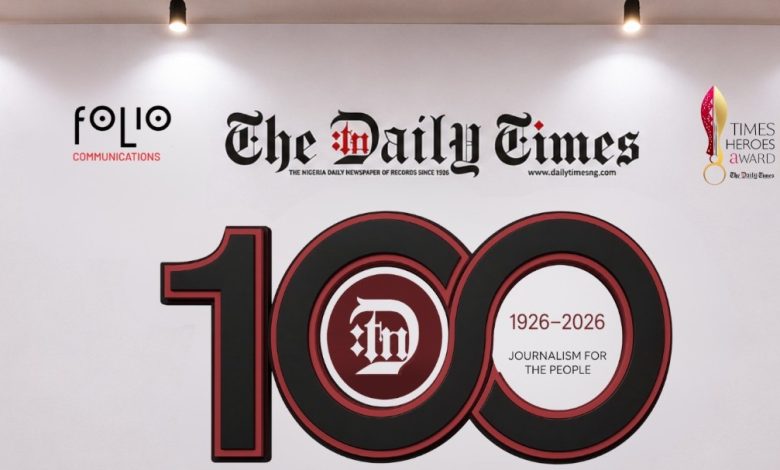
Daily Times of Nigeria (DTN), Nigeria’s oldest newspaper, is set to mark its centenary on Monday, June 1, celebrating 100 years since it was founded on 1926.
The management of the newspaper will hold a press conference at the Nigeria Union of Journalists (NUJ) Secretariat in Utako, Abuja, with the theme“Daily Times is 100 years tomorrow — celebrating 100 years of fearless journalism, championing the future 1926–2026.”
According to a schedule released on Sunday, the event will also launch a year-long calendar of activities, including public lectures, exhibitions of archival front pages, and a digital archive project aimed at making a century of Daily Times editions accessible online to researchers and the public.
The anniversary carries the broader message: “100 years honouring the past, shaping the future. 1926–2026: practicing journalism for the people.”
Founded by Richard Barrow and Ernest Ikoli as a four-page daily in colonial Lagos, Daily Times evolved into one of Nigeria’s most influential newspapers and became widely regarded as the nation’s newspaper of record.
During the nationalist movements of the 1950s, the publication served as a platform for debates around self-rule and independence. Following Nigeria’s independence in 1960, the newspaper documented major moments in the country’s history, including the First and Second Republics, the 1966 coups, the civil war, periods of military rule, and the return to democratic governance in 1999.
At its height in the 1970s and 1980s, Daily Times recorded the largest newspaper circulation in West Africa, with its Kakawa Street headquarters in Lagos becoming a prominent media landmark.
However, the last two decades have brought significant challenges for the newspaper industry, including ownership transitions, economic pressures, and digital disruption that affected print circulation.
Despite the changes, Daily Times continues to publish in print and online formats while maintaining its longstanding editorial philosophy of journalism “for the people”.
According to organisers, the centenary celebration is intended not only to reflect on the newspaper’s legacy but also to outline its future direction.
“The centenary is about honouring the past, but more importantly, shaping the future,” a senior editor said.
“We are 100 years old, but we are not a museum piece. We are championing the future of journalism in Nigeria, Africa, and the global community.”
The management is expected to announce initiatives focused on strengthening its digital operations, including a digital-first newsroom model, expansion into video and podcast content, public access to its archival collections, media literacy programmes with schools and the NUJ, and training fellowships for young reporters in investigative and solutions journalism.
Speaking on the significance of the anniversary, Fidelis Anosike, publisher and editor-in-chief of Daily Times, described the centenary as a rare achievement in African media.
“Centenaries are rare in African media. Few newspapers reach 100 years, and fewer still continue publishing,” he said.
He added that Daily Times serves as a living archive of Nigeria’s history, having documented landmark national moments as well as everyday stories that shaped public life.
Anosike said the anniversary also presents an opportunity to reflect on the role of journalism in a rapidly changing media environment.
“The world has changed since 1926, but the job has not. People still need reliable information to make decisions. That is what we have done for 100 years, and that is what we will do for the next 100,” he said.